
If you’ve searched “cant afford new roof Florida” after getting a notice from your insurer, the first step isn’t automatically signing a roofing contract. Florida law gives some homeowners an inspection option when roof age is the issue, and if replacement really is necessary, several ways may exist to pay for the project. This guide explains how to verify the insurance requirement, compare roof replacement help in Florida and decide whether options such as Ygrene PACE financing fit your situation.
What to do if you can’t afford new roof Florida insurers require
A letter saying your insurer needs information about your roof can mean several different things. The company may be asking for an inspection, identifying a condition problem, requesting repairs or making roof replacement a condition of renewal.
Read the notice closely before assuming that a complete replacement is unavoidable. Look for the deadline, the specific reason given, any inspection requirements and exactly what documentation the insurer will accept.
That distinction matters in Florida because roof age alone doesn’t always give an insurer grounds to require replacement.
Under Florida Statutes section 627.7011, an insurer generally can’t refuse to issue or renew a homeowners policy solely because a roof is less than 15 years old. For a roof that is at least 15 years old, the statute requires the insurer to allow the homeowner to obtain an inspection by an authorized inspector at the homeowner’s expense before replacement is required solely on the basis of age.
If that inspection finds at least five years of useful life remaining, the insurer generally can’t refuse issuance or renewal solely because of the roof’s age. The law also allows insurers to make underwriting decisions for other lawful reasons, so a favorable useful-life inspection doesn’t guarantee renewal if the insurer identifies another legitimate problem.
Start by finding out why the insurer is requiring a new roof
Ask your agent or insurer to clarify the basis for the requirement if the notice isn’t clear. Useful questions include:
- Is the replacement request based solely on roof age or on a documented condition problem?
- Will the insurer accept a roof useful-life inspection?
- Who qualifies as an acceptable inspector?
- Does the entire roof need replacement or would documented repairs satisfy underwriting requirements?
- What evidence must be submitted after the work?
- What is the deadline for completing the inspection, repair or replacement?
The Florida Department of Financial Services explains that insurers may use several kinds of property inspections during underwriting. A four-point inspection may evaluate the roof along with electrical, plumbing and HVAC systems while a specialized inspection may focus only on the roof and its remaining life expectancy.
Don’t assume that an insurance inspection is the same as a contractor’s sales estimate. One evaluates the condition or expected life of the roof for underwriting purposes. The other describes proposed construction work and its price.
Get the requirement in writing
If the insurer or agent explains the issue by phone, ask where that requirement appears in your written notice or policy documentation. You want to know exactly what problem needs to be resolved before spending thousands of dollars.
You should also keep copies of inspection reports, photographs, contractor estimates and communications with your insurer. They can help you compare recommendations and document what was completed.
If the insurer’s decision appears inconsistent with your policy or Florida law, speak with your insurance agent or an appropriate insurance professional. For case-specific questions about your rights, consider contacting the Florida Department of Financial Services or getting qualified legal advice rather than relying on general online guidance.
When a roof inspection could change the situation
A homeowner with a 16-year-old roof may hear “your roof is too old” and immediately start looking for financing. That can be premature.
Suppose, hypothetically, the roof has been maintained, has no active leaks and an authorized inspection concludes that it has more than five years of useful life remaining. If age was the sole reason for the insurer’s decision, Florida’s statutory protection may allow the homeowner to avoid an immediate replacement.
The outcome could be different if an inspection finds deterioration, storm damage, failing materials or another condition that doesn’t meet the insurer’s underwriting requirements. At that point, replacement or specific corrective work may genuinely be needed.
This is why homeowners looking for help because their insurance is requiring a new roof should separate two questions:
- Does the roof actually need to be replaced now to satisfy the insurer?
- If it does, how will I pay for the project?
Answer the first question before committing to the second.
Get more than one roofing proposal when time allows
If replacement is confirmed, obtain detailed written estimates from licensed contractors. Compare the scope of work rather than looking only at the total price.
A useful proposal should make it possible to understand what materials and work you’re paying for. Depending on the project, that can include removal of existing roofing, deck repairs, underlayment, roof covering, flashing, ventilation, permits and any code-required work.
Also ask how unexpected conditions discovered after tear-off will be priced. A proposal that appears cheaper at first can change significantly if important work was excluded.
Florida law recognizes roof repair, replacement and certain wind-resistance improvements as qualifying residential improvements under the state’s PACE framework. These include work involving roof deck attachment, secondary water barriers, wind-resistant shingles, gable-end bracing and roof-to-wall connections.
That doesn’t mean every proposed roofing expense automatically qualifies for a particular financing program. Project eligibility and property eligibility still need to be confirmed.
Roof replacement help Florida homeowners can compare
Once you’ve confirmed that replacement is necessary, compare funding methods based on your own finances and timeline. An urgent insurance deadline may limit how long you can shop around, but it shouldn’t prevent you from reviewing the total obligation before signing.

There isn’t one funding method that works best for every homeowner.
| Option | How it may help | What to review carefully |
| Cash or savings | Avoids financing charges and future payment obligations | Whether using the money would leave enough emergency savings for other expenses |
| Personal loan | May provide funds without using home equity | Interest rate, origination fees, monthly payment, term and total repayment |
| Home equity loan or HELOC | May allow you to borrow against available home equity | Qualification requirements, variable versus fixed rates, closing costs and the effect of additional debt secured by the home |
| Contractor financing | Can be arranged as part of the roofing purchase | Who actually provides the financing, promotional terms, deferred interest provisions, fees and total repayment |
| PACE financing | May finance a qualifying roof improvement through a property assessment | Property eligibility, interest rate, finance charges, assessment payments, lien priority and sale or refinance implications |
| Assistance or mitigation program | Some homeowners may qualify for specific public programs | Current eligibility, funding availability, covered work and application requirements |
The right comparison isn’t simply “Which option has the lowest payment?” A longer repayment term can reduce the amount due at any one time while increasing the period over which financing costs accrue.
Compare the annual percentage rate or applicable rate information, fees, total amount financed, repayment period and total amount you expect to repay. Also consider whether the payment structure fits the way you manage household expenses.
Check legitimate assistance programs before assuming financing is your only choice
Some Florida homeowners may be eligible for state, local or other assistance programs connected with hurricane mitigation or housing repairs. Program eligibility and funding can change, so verify current requirements directly with the administering agency.
Don’t assume that PACE is a grant or government assistance program. Ygrene expressly states that its PACE financing requires repayment and isn’t a government-sponsored grant, subsidy or free-service program.
Similarly, don’t pay someone who claims they can guarantee a government roof grant without first confirming the program through an official government source.
Consider how quickly each option can realistically work
An insurer’s deadline can make timing part of the financing decision.
Ask each provider what documents you need and what must happen before the contractor can begin. A lender may require income and credit documentation. A home equity product may involve property-related underwriting. A contractor financing program will have its own credit and contract requirements.
With PACE, both the property and proposed project must meet program requirements. Ygrene also operates only in participating jurisdictions rather than every Florida address. Its current Florida service area page lists availability in 24 counties but individual cities, unincorporated areas and property types can differ within those counties.
Confirm your exact property address rather than assuming county-level availability means your home qualifies.
How Ygrene PACE financing can work for a qualifying roof
Property Assessed Clean Energy, or PACE, financing is different from a conventional personal loan.
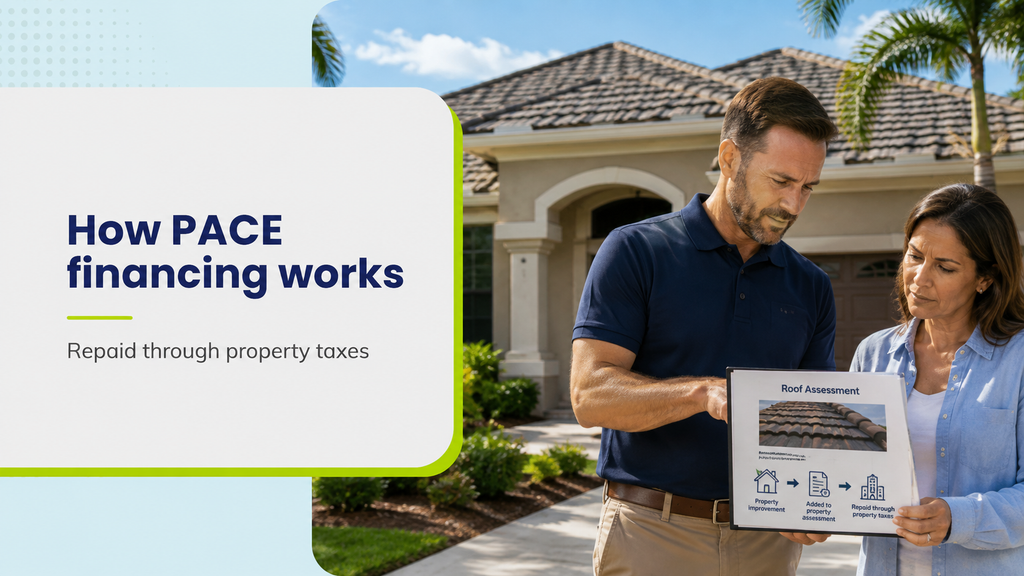
Ygrene describes its residential PACE financing as a property assessment secured by the improved property. Repayment is made with property taxes and a recorded first-priority lien secures the amount financed. Because this structure creates an obligation tied to the property, homeowners should understand the assessment and its mortgage implications before choosing it.
Ygrene’s current Florida program includes roofing among its eligible PACE improvement categories. The current list also includes qualifying windows, doors, HVAC equipment, sewer and septic work, storm-resilience measures and other improvements. Actual eligibility depends on the property, jurisdiction and proposed work.
What happens during the Ygrene process
According to Ygrene’s current PACE financing process, homeowners apply for financing, Ygrene reviews property and ability-to-repay requirements and the proposed project must qualify. The homeowner chooses the contractor and the contractor performs the work. Ygrene states that it pays the contractor after the completed work is verified.
Ygrene currently offers residential repayment terms of up to 20 years, depending on the service area and improvement. It uses fixed rates and performs a soft credit pull to verify underwriting information, which it states doesn’t affect the applicant’s credit score. Eligibility still involves property equity, income and other underwriting requirements.
For homeowners focused on Florida roof replacement financing, that structure can provide another option when paying the full project cost upfront isn’t practical. It still needs to be compared with other available funding methods based on total cost and the homeowner’s longer-term plans.
How repayment through property taxes works
Ygrene states that the PACE assessment appears as a line item on the property tax bill.
If you pay property taxes through a mortgage escrow account, your mortgage servicer generally collects money toward the property-tax obligation through your regular escrow process. If you pay taxes directly, the assessment is paid with the property-tax bill according to the applicable tax schedule.
That payment structure deserves close attention. Adding an assessment can increase the amount that must be collected for property taxes, including the amount a servicer needs to collect through escrow.
Before signing, review how the estimated assessment could affect your household cash flow and ask your mortgage servicer how it handles PACE assessments.
Understand the recorded lien before proceeding
Ygrene’s current disclosures state that PACE financing is secured through a recorded first-priority lien on the improved property.
That has practical consequences beyond how you make the payments. Ygrene says homeowners will very likely need to pay off the remaining PACE financing when selling or refinancing because many mortgage lenders require payoff as a condition of the transaction. The assessment must also be disclosed to potential buyers.
If you expect to move or refinance in the near future, investigate this before choosing PACE. Ask Ygrene for the applicable payoff terms and speak with your mortgage lender or real estate professional about how the assessment may affect your plans.
Ygrene currently states that residential customers may make full or partial early payments without a prepayment penalty, subject to its current terms. Confirm the provisions in your own financing agreement rather than relying on a general website description.
A practical checklist before you replace or finance the roof
An insurance deadline can make the process feel rushed. A written workflow helps you avoid skipping decisions that could affect your finances for years.
- Read the insurance notice in full. Identify whether the problem is roof age, roof condition, missing documentation or another underwriting issue.
- Ask whether an inspection is available. If your roof is at least 15 years old and age is the reason for the replacement requirement, review the inspection rights provided by Florida law.
- Confirm exactly what work will satisfy the insurer. Don’t assume a full replacement is required if the notice calls for inspection, repair or documentation.
- Obtain detailed contractor proposals. Compare the project scope, materials, warranties, exclusions and procedures for unexpected work.
- Check the contractor separately from the financing. Construction quality, project scope and warranty obligations belong to your contractor. Ygrene’s FAQ states that workmanship and warranty issues remain the contractor’s responsibility.
- Compare the complete financing obligation. Review the amount financed, rate, finance charges, repayment term, total repayment, assessment schedule and any fees rather than relying only on an advertised payment.
- Check property and project eligibility before assuming PACE will work. Ygrene’s availability depends on participating Florida jurisdictions and applicable underwriting requirements.
- Consider your mortgage and future plans. Ask how the assessment could affect escrow, refinancing, a home sale or an early payoff.
- Review every agreement before signing. The contractor agreement and financing agreement create different responsibilities. Read both.
- Get professional advice where your circumstances require it. An insurance agent, mortgage professional, financial adviser, tax professional, attorney or real estate professional may be appropriate when the decision depends on your individual policy or finances.
A hypothetical Florida homeowner example
Consider a homeowner who receives a renewal notice requiring action on a 17-year-old roof.
First, the homeowner asks whether the insurer’s concern is solely age. If so, the homeowner arranges an inspection from an inspector who meets the statutory requirements. If the report finds fewer than five years of useful life remaining and the insurer still requires replacement, the homeowner gets three roofing proposals.
The homeowner doesn’t have enough savings to pay the chosen contractor upfront. They compare a personal loan, available home equity financing, contractor financing and PACE financing.
If the property is within a Ygrene service area and the roof project qualifies, the homeowner then reviews the PACE assessment alongside the other options. Rather than comparing payments alone, they compare total financing cost, repayment length, the property-tax impact and what would happen if they refinance or sell before the assessment is paid off.
The final decision depends on that household’s finances, property and plans. The useful part of the process is that the homeowner has separated the insurance problem, roofing project and financing decision instead of treating them as one rushed transaction.
Questions to answer before signing any roof financing agreement
When a roof replacement is urgent, it’s easy to focus on whether you can get approved. Approval is only one part of the decision.
Before signing, make sure you can answer these questions:
- What is the complete installed price in my contractor agreement?
- How much am I financing after any cash contribution?
- What rate and finance charges apply?
- What will I repay over the full term if I follow the scheduled payments?
- When does interest begin accruing?
- When is my first required payment?
- How will repayment affect my property-tax bill or mortgage escrow?
- Is the obligation secured by my property?
- Can I pay it off early and what procedure applies?
- What could happen to the financing if I sell or refinance?
- Who is responsible if I have a workmanship or warranty dispute?
- Which documents confirm that the completed roof meets my insurer’s requirements?
Ygrene states that a customer service representative reviews terms and conditions with customers before they sign the financing agreement. That review is an opportunity to ask questions, but homeowners should still read their documents independently and seek professional advice when an individual legal, tax, insurance or mortgage issue needs expert review.
Check whether your roof project and property are eligible
If your insurer has confirmed that the roof must be replaced, first settle on the scope and price of the work. Then compare funding options using their full costs and obligations rather than choosing solely on the size of the scheduled payment.
For homeowners considering PACE, Ygrene currently offers financing for qualifying roof projects in approved Florida jurisdictions. Check whether your address and proposed improvement are eligible, then review the financing agreement, assessment amount, rate, repayment schedule, total repayment, lien terms and possible sale or refinance implications before deciding whether it fits your situation.
FAQs
Can my Florida insurer make me replace a 15-year-old roof?
Not solely because it has reached 15 years of age without first allowing the inspection process described in Florida law. For a roof at least 15 years old, an authorized inspection may establish remaining useful life. An insurer can still consider other lawful underwriting issues unrelated to age alone.
What if my roof inspection says it still has five years of life?
Florida law says an insurer generally can’t refuse to issue or renew a homeowners policy solely because of roof age when an authorized inspection finds at least five years of useful life remaining. Other underwriting conditions may still apply, so submit the report as required and confirm the insurer’s decision in writing.
Does homeowners insurance pay for replacing an old roof?
A requirement from an insurer to replace an aging roof doesn’t automatically mean the replacement is a covered insurance claim. Coverage depends on your policy and the reason the roof needs work, so ask your insurer or agent to explain what your policy covers rather than assuming an age-related replacement will be paid for.
Is Ygrene PACE financing a roof loan?
No. Ygrene describes PACE financing as a property assessment rather than a conventional loan. The assessment is secured by the property through a recorded first-priority lien and repayment is made through property taxes.
Does a roof replacement qualify for Ygrene PACE financing in Florida?
Roof repair, replacement and specified roof-resilience improvements are recognized as qualifying residential improvements under Florida’s PACE statute. Ygrene also currently lists roofing among its eligible Florida projects, but the specific property, jurisdiction and project still need to meet program requirements.
Will Ygrene PACE financing affect my credit score?
Ygrene says it performs a soft credit pull to verify underwriting criteria and that the inquiry doesn’t affect the applicant’s credit score. Approval isn’t guaranteed and Ygrene still reviews property equity, income and other eligibility requirements.
What happens to PACE financing if I sell or refinance?
Ygrene states that homeowners will very likely need to pay off the remaining assessment during a sale or refinance because many mortgage lenders require full payoff. If you may sell or refinance, review this issue with Ygrene and your lender before signing.