
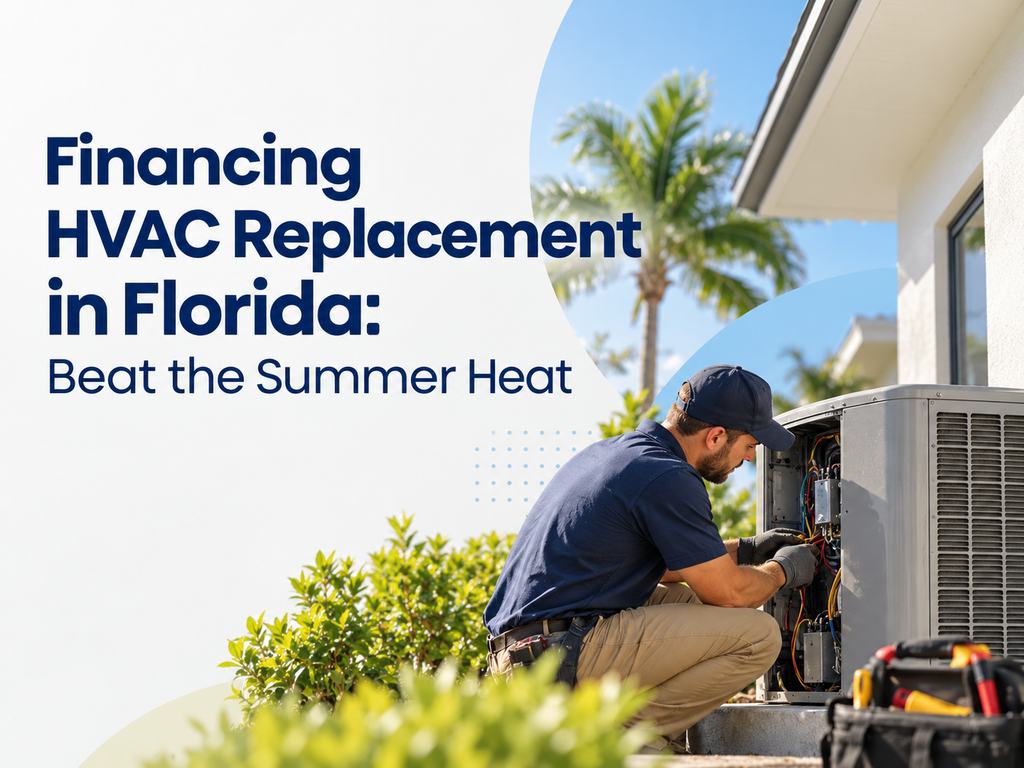
When an air conditioner fails in Florida, replacement can quickly move from a planned home improvement to a necessary expense. For homeowners researching HVAC financing Florida options, the challenge is finding a way to complete the work without making a rushed financial decision.
This guide explains how to plan an HVAC replacement, what to review in a contractor proposal, how PACE financing works for qualifying systems and how to compare it with other ways to pay.
Why HVAC replacement can become an urgent Florida home project
Florida homeowners depend heavily on cooling for much of the year. A system that struggles to maintain a comfortable indoor temperature can become much harder to ignore once consistently hot weather arrives.
Not every HVAC problem requires replacing the entire system. A failed component, thermostat issue, blocked drain or damaged duct may be repairable. Before deciding on replacement, have a qualified HVAC contractor diagnose the system and explain why repair or replacement makes more sense.
When replacement is recommended, homeowners should look beyond the price of the outdoor condenser alone. A complete project could involve the indoor air handler, heat pump, duct repairs, controls, electrical work or other changes needed for the new equipment to operate correctly.
The U.S. Environmental Protection Agency’s ENERGY STAR program recommends proper HVAC system sizing and installation based on the characteristics of the home rather than relying on a simple rule of thumb. Oversized equipment can cycle too frequently while poor airflow, incorrect refrigerant charge and duct leakage can reduce comfort and system performance.
That makes the contractor proposal an important part of the financing decision. Before asking how to pay for a new system, make sure you understand what you’re actually paying for.
What to ask before approving an AC replacement
A homeowner comparing proposals should ask the contractor:
- Is full replacement necessary or is repair still practical?
- Which indoor and outdoor components are included?
- How was the new system sized for the home?
- Will the existing ductwork be inspected?
- Does the proposal include duct repairs or sealing if needed?
- What efficiency rating does the proposed equipment have?
- Are electrical, permitting and disposal costs included?
- What manufacturer and contractor warranties apply?
- Are there optional upgrades that can be separated from necessary work?
- What is the total installed project price?
A properly sized system should reflect the home’s cooling needs, insulation, windows, air leakage and other relevant conditions. Oversizing can add unnecessary equipment cost and cause frequent cycling that affects comfort and efficiency.
A detailed proposal gives you something meaningful to finance and makes it easier to compare contractors on more than the bottom-line number.
What air conditioner financing Florida homeowners can consider
There isn’t one financing method that works best for every household. The right choice depends on the project cost, available cash, credit profile, home equity, repayment structure and how long you expect to own the property.
Common ways to pay for an AC replacement include cash, contractor financing, personal loans, home-equity products and PACE financing where available.
| Option | How it generally works | What to review |
| Cash | Pay the contractor without financing the project | Effect on emergency savings and other planned expenses |
| Personal loan | Borrow through a conventional lender and repay through regular installments | Rate, fees, term, monthly payment and total repayment |
| Home-equity financing | Borrow against available home equity | Qualification requirements, closing costs, repayment structure and property-related obligations |
| Contractor financing | Financing is arranged through or offered alongside the HVAC contractor | Provider, promotional terms, rate changes, fees and total cost |
| PACE financing | Eligible improvements are financed through a property assessment. A first-priority lien for the total amount financed is placed on the property as collateral. | Assessment amount, rate, finance charges, property-tax repayment, lien and sale or refinance considerations |
A low monthly payment shouldn’t be the only factor you compare. Longer repayment can reduce the size of individual payments while increasing the period over which financing costs accumulate.
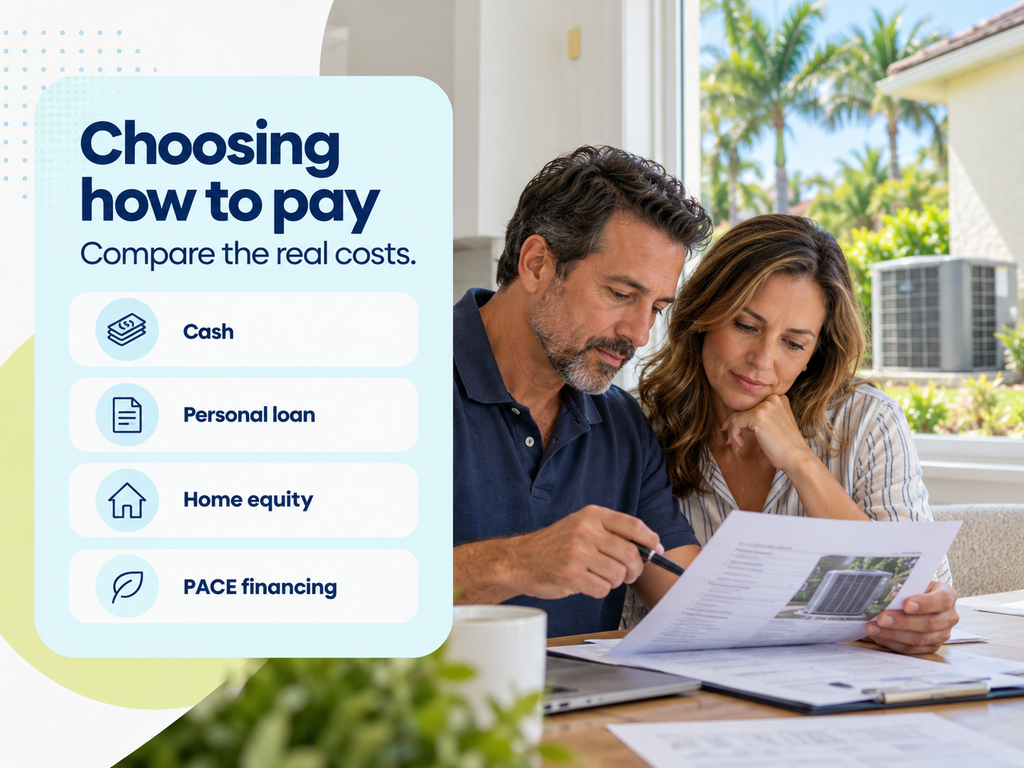
For each option, compare the amount being financed, interest rate, finance charges, repayment schedule, total amount repaid and any early-payoff conditions.
You should also consider the relationship between the financing and your home. A conventional unsecured personal loan and a property-based PACE assessment don’t create the same obligations.
Don’t let an HVAC failure rush the financing decision
Imagine a hypothetical homeowner in South Florida whose older central air conditioner fails during a hot week.
One contractor recommends replacing the complete system and provides a detailed estimate. Another offers a lower price but leaves several items unclear, including duct work and electrical modifications.
The homeowner also has several payment options available.
The quickest path might appear to be signing the first contractor financing offer presented at the kitchen table. A better process is to confirm the project scope first, request complete financing disclosures and compare the total obligation before authorizing the work.
An urgent HVAC problem can justify moving quickly. It doesn’t require skipping the basic financial review.
How PACE HVAC financing works in Florida
Property Assessed Clean Energy, or PACE, is a form of financing for qualifying improvements attached to a property. It isn’t structured like a conventional personal loan with a separate monthly loan bill.
Under Section 163.08 of the Florida Statutes, energy conservation and efficiency improvements may qualify for PACE financing, including certain heating, cooling and ventilation systems. Residential PACE programs must also be authorized in the applicable county or municipality.
Ygrene includes heating and cooling improvements among its financing categories. Its current list of PACE-eligible home improvements includes central HVAC systems and certain related cooling, heat pump, ventilation and duct projects. Eligibility still depends on the specific property, project and applicable program requirements.
With Ygrene PACE financing, a qualifying improvement is financed through an assessment secured by the improved property. Repayment is made through the property-tax system rather than through a conventional monthly personal-loan account. A first-priority lien for the total amount financed will be placed on the property as collateral. Ygrene’s PACE program is not a government sponsored program and there is no government assistance available to pay the assessment.
The assessment is secured by a recorded lien on the property. That distinction matters when comparing AC replacement financing because PACE creates property-related obligations that may affect future financial decisions.
Availability depends on your address
PACE isn’t automatically available at every Florida property.
Ygrene operates in participating Florida jurisdictions, and program availability can differ depending on the location and property type.
Some jurisdictions may permit commercial PACE but not residential PACE. That means homeowners shouldn’t assume that a program is available throughout an entire county simply because it operates somewhere nearby.
Before building your HVAC replacement plan around PACE, review Ygrene’s current Florida service areas and confirm that residential financing is available for your property’s address.
PACE financing is tied to the property
The property-based structure is one of the biggest differences between PACE and ordinary consumer credit.
Because an assessment and lien are associated with the property, homeowners should pay particular attention to what could happen if they sell or refinance before the assessment has been paid in full.
Most mortgage lenders require the remaining PACE obligation to be repaid as a condition of a sale or refinance. Although property assessments may be transferable under certain circumstances, homeowners shouldn’t assume that the next buyer can or will take over the remaining balance.
If you expect to move or refinance soon, investigate that issue before choosing PACE rather than assuming the assessment will simply remain with the property.
How to use HVAC financing Florida homeowners can evaluate carefully
When the air conditioner isn’t working, it’s tempting to start with the question, “How much can I finance?”
Start with the project instead.
The goal is to finance the appropriate HVAC work on terms you understand, rather than letting the available financing amount determine the size of the project.
Step 1: Get the system professionally evaluated
Ask a licensed HVAC contractor to identify the failure and explain whether replacement is necessary.
If replacement is recommended, request the proposed equipment specifications and complete project scope.
For a PACE-financed project, also confirm that the contractor meets the applicable licensing and program participation requirements.
Step 2: Compare complete HVAC proposals
Two estimates aren’t comparable when one includes duct repairs, electrical upgrades and permitting while the other covers only equipment replacement.
Ask each contractor for enough detail to identify:
- Equipment being installed
- Equipment efficiency and capacity
- Indoor and outdoor components
- Duct work
- Controls or thermostat
- Electrical modifications
- Permits
- Labor
- Disposal of existing equipment
- Warranties
- Total installed price
If one estimate is substantially different, ask why.
Step 3: Confirm the improvement qualifies
If you’re considering Ygrene PACE financing, check that the exact HVAC improvement appears among currently eligible projects.
Central HVAC systems and certain related heating, cooling and duct improvements may qualify. However, the presence of an improvement category on an eligibility list doesn’t mean every equipment model, project proposal or property will qualify.
Ask whether any optional improvements included in the contractor’s proposal are eligible for the same financing.
Step 4: Confirm that PACE is offered at the property
Program availability depends on local participation.
Check the property address against current program coverage before relying on PACE to pay the contractor.
If the jurisdiction isn’t participating or residential financing isn’t available, you’ll need to consider another funding method.
Step 5: Review the financing agreement separately from the contractor agreement
These documents answer different questions.
The contractor agreement explains what will be installed, how much the project costs and what responsibilities the contractor has.
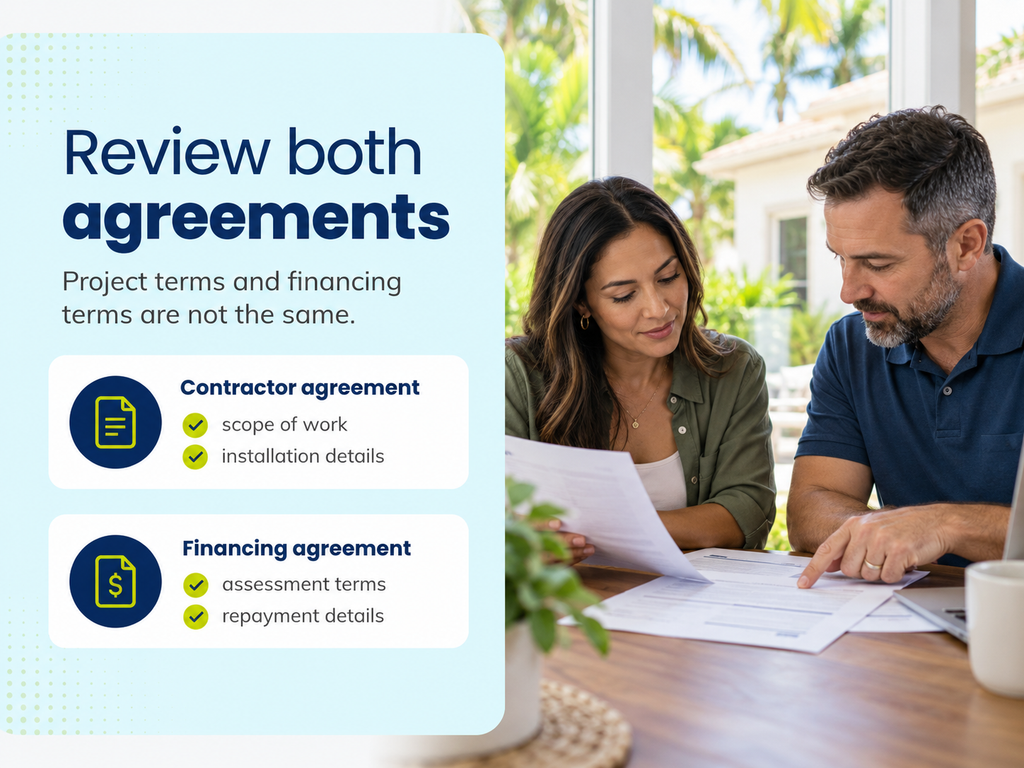
The financing agreement explains what you’re agreeing to pay.
For PACE financing, review the assessment amount, rate, finance charges, repayment period, repayment schedule, total repayment amount and any terms related to early payoff.
Ygrene’s consumer protection practices include reviewing financing terms and conditions with homeowners before signing. Use that opportunity to ask questions about any part of the agreement you don’t fully understand.
A financing disclosure shouldn’t be treated as a formality. It explains obligations that can continue long after the new air conditioner is installed.
Step 6: Understand the property-tax impact
PACE repayment should be considered part of your housing expenses rather than treated as an unrelated HVAC bill.
Ygrene explains that the assessment appears as a line item on the property-tax bill. Homeowners who pay property taxes through a mortgage escrow account should understand how the new assessment could affect their particular mortgage and escrow arrangement.
For example, adding an assessment may increase the amount your mortgage servicer needs to collect for property taxes. The timing and amount of any escrow adjustment depend on your individual mortgage servicing arrangement.
Before signing, ask how the assessment will be billed and when the first payment is expected.
For questions about your specific escrow calculation, contact your mortgage servicer.
Step 7: Compare PACE with realistic alternatives
Don’t compare PACE only with the option of doing nothing.
Compare it with alternatives you could actually use.
For example, someone with sufficient savings might compare the total cost of financing with the effect of using cash. Someone with strong credit might compare conventional borrowing. Someone with substantial equity may want to investigate home-equity financing.
Look at the complete repayment obligation rather than focusing only on whether you can handle the first payment.
Step 8: Think about your ownership plans
If there’s a meaningful chance you’ll sell or refinance during the financing term, investigate the payoff requirements now.
Ygrene addresses property assessments, early payoff, mortgage implications and other repayment considerations in its PACE financing FAQs.
Discuss your individual circumstances with your mortgage lender before deciding whether property-based financing makes sense.
Step 9: Keep copies of everything
Save the HVAC proposal, financing agreement, disclosures, permits, equipment information and warranty documents.
These records can be useful for future service work and for understanding the financing obligation after the installation is complete.
You should also keep a record of the contractor’s installation details, including equipment model numbers and any work completed on ducts, wiring or controls.
What to review before financing an AC replacement
An HVAC replacement combines two decisions: choosing the equipment and choosing how to pay for it.
Treat them separately.
A strong contractor proposal doesn’t automatically make the financing attractive. Likewise, convenient financing doesn’t make an unnecessarily expensive or poorly specified HVAC project a good purchase.
Before signing, make sure you can answer the following questions.
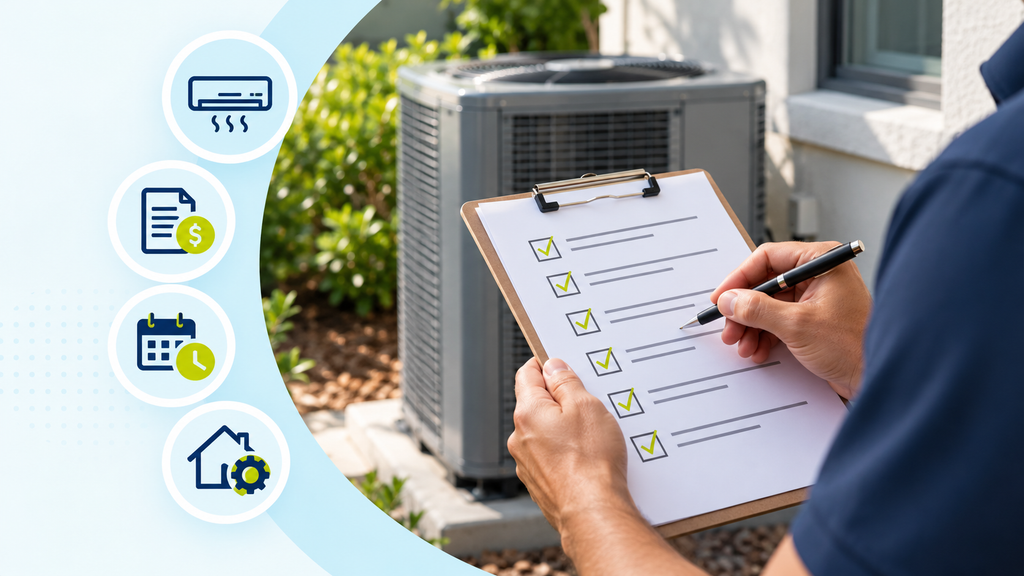
About the HVAC project
Do you know why the system needs replacement?
Do you understand which components are included?
Has the contractor explained how the equipment was sized?
Has the duct system been evaluated?
Do you know which optional upgrades have been added to the proposal?
Are permits, labor and disposal included?
Do you understand the warranties?
About the financing
What amount are you financing?
What rate applies?
What finance charges and fees apply?
How long does repayment last?
What is the total expected repayment?
How and when are payments collected?
Can the obligation be paid off early and what conditions apply?
What happens if you sell the home?
What happens if you refinance your mortgage?
Will the financing affect your property tax or mortgage escrow payments?
What lien or security interest is associated with the financing?
These questions are especially important with PACE because the repayment structure is tied to the property.
Florida’s residential PACE consumer protection requirements under Section 163.085 address financing disclosures and prohibit misleading representations about government assistance, free improvements and tax deductibility.
PACE financing isn’t a government program, grant or subsidy. Homeowners remain responsible for repayment under the financing agreement.
If tax treatment matters to your decision, speak with a qualified tax professional rather than assuming that a PACE assessment will receive a particular tax treatment.
Why the lowest HVAC estimate isn’t always the best value
Cost matters, especially when an air conditioner needs immediate replacement. However, a lower initial estimate can be misleading if it leaves out necessary work.
Consider two hypothetical proposals for the same Florida home.
The first includes a complete indoor and outdoor system replacement, duct inspection, required electrical modifications and permitting.
The second lists only the major HVAC equipment and basic installation labor.
The second proposal may look more affordable initially, but additional work could be needed once installation begins.
Financing the lowest estimate without understanding the missing items could result in unexpected costs.
Before agreeing to a project, request a written explanation of what isn’t included and how changes to the scope would be approved and charged.
Why energy efficiency matters when comparing replacement systems
A more efficient cooling system may use less electricity than an older or less efficient model under comparable conditions. Actual savings depend on equipment selection, usage, climate, installation quality and the condition of the home.
Florida homeowners should consider efficiency alongside system sizing, equipment compatibility and installation quality.
A higher-efficiency system may carry a higher initial purchase price. The additional cost should be evaluated against its expected benefits and the total amount financed.
Don’t assume that choosing the most expensive equipment automatically produces the best financial outcome.
An appropriate system should meet the home’s cooling requirements without creating unnecessary project or financing costs.
Check your HVAC project before the next hot spell
Replacing an air conditioner is easier to plan when you’re not making every decision after the system has already stopped cooling.
If an older HVAC system is showing signs of trouble, consider getting it inspected before peak cooling demand exposes a larger problem. That gives you more time to compare contractors, confirm system sizing and investigate financing without making a same-day decision.
For homeowners considering HVAC financing Florida options, Ygrene PACE financing may be one path for qualifying HVAC improvements in participating jurisdictions.
The important first steps are confirming that your address is served, checking that the proposed project is eligible and reviewing the full property assessment and repayment obligation.
If your HVAC system needs replacement, explore how Ygrene PACE financing works and check your property’s eligibility before comparing the available terms with other ways to fund your project.
FAQs
Can you finance a new air conditioner in Florida?
Yes. Florida homeowners may have several ways to finance an AC replacement, including conventional financing, contractor programs, home-equity products and PACE financing for qualifying improvements in eligible jurisdictions. Compare the complete costs and repayment obligations rather than choosing based only on the advertised payment.
Can an HVAC replacement qualify for Ygrene PACE financing?
Certain HVAC improvements, including central heating and cooling systems and eligible related equipment, may qualify for Ygrene PACE financing. The property, jurisdiction and specific project must still meet current program requirements.
Is PACE financing the same as an HVAC loan?
No. PACE financing uses a property assessment secured by the improved property and repayment is made through the property-tax system. A first-priority lien for the total amount financed will be placed on the property. A conventional HVAC or personal loan usually has a separate lending agreement and repayment schedule, so homeowners should compare the structures carefully.
Does Ygrene PACE financing use a credit score for approval?
Ygrene states that approval is based on factors including home equity and income rather than the homeowner’s credit score. Ygrene also states that it performs a soft credit pull to verify certain underwriting criteria and that the inquiry doesn’t affect the credit score. Other eligibility requirements still apply.
Does PACE financing appear on the property tax bill?
Yes. Ygrene PACE assessments appear as a line item on the property-tax bill. Homeowners who pay their property taxes through a mortgage escrow account should ask their mortgage servicer how the assessment may affect their escrow payments.
What happens to PACE financing if I sell or refinance?
Sale and refinance can create important payoff considerations. Most mortgage lenders require the remaining PACE obligation to be paid off during a sale or refinance. Homeowners should review their financing agreement and discuss their individual situation with their mortgage lender before proceeding.
What should I compare when choosing AC replacement financing?
Compare the amount financed, interest rate, finance charges, repayment period, payment structure and total repayment amount. Also review whether the financing creates a property-related obligation, what early payoff involves and how the financing could affect a future sale or refinance.