
If you searched “insurer drop old roof Florida,” the answer is more nuanced than a simple yes or no. Florida law limits when an insurer can refuse to issue or renew a homeowners policy solely because of roof age. Once a roof reaches 15 years, inspection results become especially important.
This guide explains Florida’s current roof-age rules, what a nonrenewal notice means, when an inspection may help and what to consider if replacement becomes necessary.
Can an insurer drop you for an old roof in Florida in 2026?
Florida law gives homeowners specific protections when roof age is the reason an insurance company doesn’t want to issue or renew coverage.
Under Florida Statute 627.7011, an insurer can’t refuse to issue or renew a homeowners policy solely because a residential structure’s roof is less than 15 years old.
For roofs that are at least 15 years old, the statute creates another protection. Before requiring replacement as a condition of issuing or renewing a policy, the insurer must allow the homeowner to obtain a roof inspection by an authorized inspector at the homeowner’s expense. If that inspection finds that the roof has at least five years of useful life remaining, the insurer can’t refuse to issue or renew the homeowners policy solely because of roof age.
That is the basis for what homeowners commonly call the 15 year roof rule in Florida.
There are two details homeowners shouldn’t overlook.
First, the law addresses refusal to issue or renew based solely on roof age. It doesn’t make every older roof automatically insurable. The same statute specifically preserves an insurer’s ability to reject or nonrenew coverage for other lawful reasons, including certain underwriting criteria.
Second, “dropped” can describe several different insurance actions. A nonrenewal means your insurer won’t continue the policy after its normal expiration date. Cancellation means the policy ends before its scheduled expiration. The Florida Department of Financial Services explains this distinction in its homeowners insurance consumer guidance.
For most homeowners dealing with roof age, the issue is a renewal decision rather than an immediate midterm cancellation.
Did Florida change the 15-year roof rule in 2026?
No enacted 2026 legislation has replaced the current rule as of August 2026.
House Bill 815 and Senate Bill 808 proposed changes to the roofing requirements for property insurance. Both bills died in committee on March 13, 2026, according to the official Florida Senate legislative record for House Bill 815.
That means homeowners should rely on the current version of Section 627.7011 rather than articles describing those 2026 proposals as if they became law.
What the 15-year roof rule does and doesn’t protect
The 15-year threshold isn’t an automatic expiration date for a Florida roof.
A roof doesn’t suddenly become uninsurable on its fifteenth birthday. Instead, reaching 15 years changes how an insurer may handle roof age when deciding whether to issue or renew certain homeowners coverage.
The Florida Department of Financial Services summarizes Florida’s property insurance changes, including the protections relating to roof age and inspections.
How Florida calculates roof age
Florida’s statute also addresses an issue that can create confusion when a roof has been repaired in stages.
For purposes of the roof-age provision, age is generally calculated from the last date when 100% of the roof surface was built or replaced according to the building code in effect at that time. The statute also accounts for successive partial replacements that ultimately result in 100% of the roof surface being replaced.
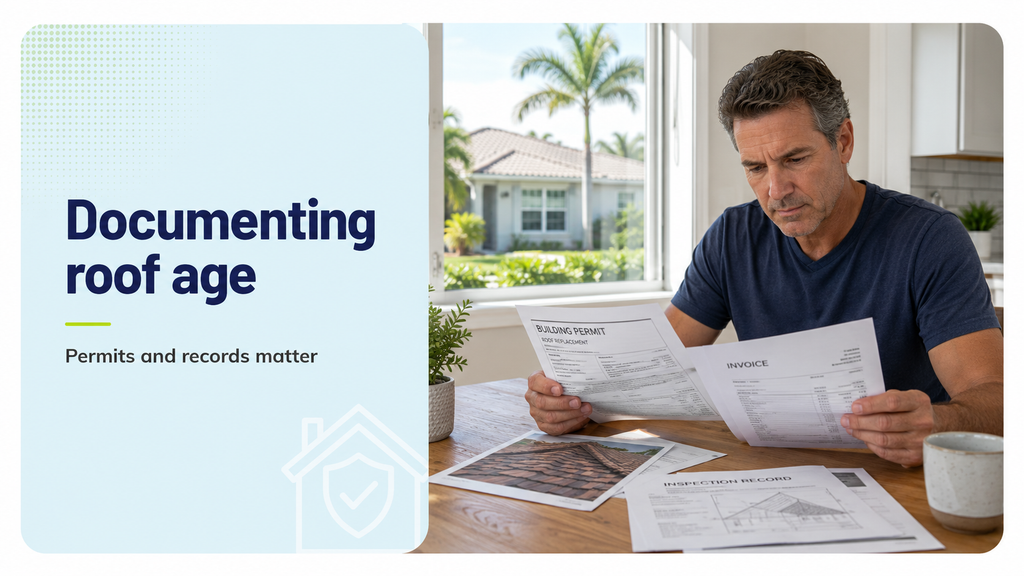
Keep invoices, permits, inspection records and contractor documentation from previous roofing work. If an insurer’s records show an older installation date than yours, those documents may help establish when the roof was actually replaced.
Who can perform the inspection?
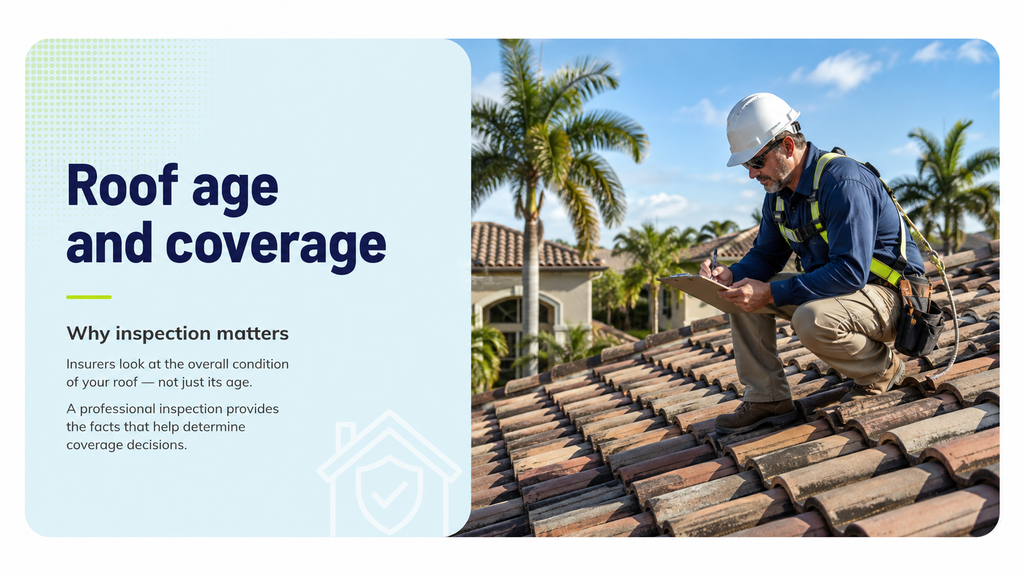
The statute defines an authorized inspector as someone approved by the insurer who falls into an accepted professional category.
That can include:
- A licensed home inspector
- A certified building code inspector
- A licensed general, building, residential or roofing contractor
- A licensed professional engineer
- A licensed professional architect
- Another qualified person or entity recognized by the insurer
Because insurer approval is part of the statutory definition, don’t simply order an inspection without first confirming what your carrier will accept.
Ask the insurer or your agent whether it requires a specific inspection form, photographs, roof certification, remaining-useful-life estimate or other supporting documents.
What if the inspection shows five or more years of useful life?
If an authorized inspection concludes that the roof has at least five years of useful life remaining, Florida law says the insurer can’t refuse to issue or renew the homeowners policy solely because of roof age.
That last phrase matters.
An inspection that satisfies the roof-age rule doesn’t guarantee renewal. The insurer may identify another lawful underwriting issue involving the property’s condition, coverage form or other factors allowed under Florida law and the policy.
For that reason, treat the inspection as evidence addressing the age issue rather than as a certificate guaranteeing insurance coverage.
Does the rule apply to every type of property policy?
No. Section 627.7011 states that this particular provision doesn’t apply to policies that aren’t considered homeowners policies and doesn’t apply to mobile home policies.
If you have a dwelling policy, mobile home policy, landlord policy or another form of property insurance, ask your licensed insurance professional which rules apply to your contract.
What to do after a roof age policy non renewal notice
A roof age policy non renewal notice is time-sensitive, but it doesn’t always mean you need to sign a roof replacement contract immediately.
Start by determining exactly why the insurer is taking action.
Florida’s Department of Financial Services says a nonrenewal occurs when coverage ends at the policy’s normal expiration date. It also states that insurers generally must provide a specific reason for nonrenewal and advance written notice, subject to applicable exceptions. Its current homeowners insurance guidance explains the applicable notice requirements.
Read the actual notice instead of relying on a phone summary from an agent, contractor or other third party.
| What you find in the notice | What it may mean | Practical next step |
| The roof is under 15 years old and age is the stated reason | Florida law restricts an age-only refusal to issue or renew | Verify the roof installation date and ask the insurer to explain its decision in writing |
| The roof is 15 years or older and replacement is requested | You may have an inspection option before replacement is required solely because of age | Ask which authorized inspectors and documentation the insurer accepts |
| The insurer cites visible deterioration or damage | The issue may involve roof condition rather than age alone | Get the condition evaluated and ask exactly what must be corrected |
| The insurer accepts an inspection showing five or more years of useful life | Roof age alone shouldn’t support refusal to issue or renew under the statute | Confirm the carrier’s renewal decision and any remaining underwriting conditions |
| Replacement is required for another lawful underwriting reason | The statutory roof-age protection may not resolve the issue | Get written requirements, roofing estimates and alternative insurance quotes before deciding |
A step-by-step response to a nonrenewal notice
Use the following process before spending money on work you may not need.
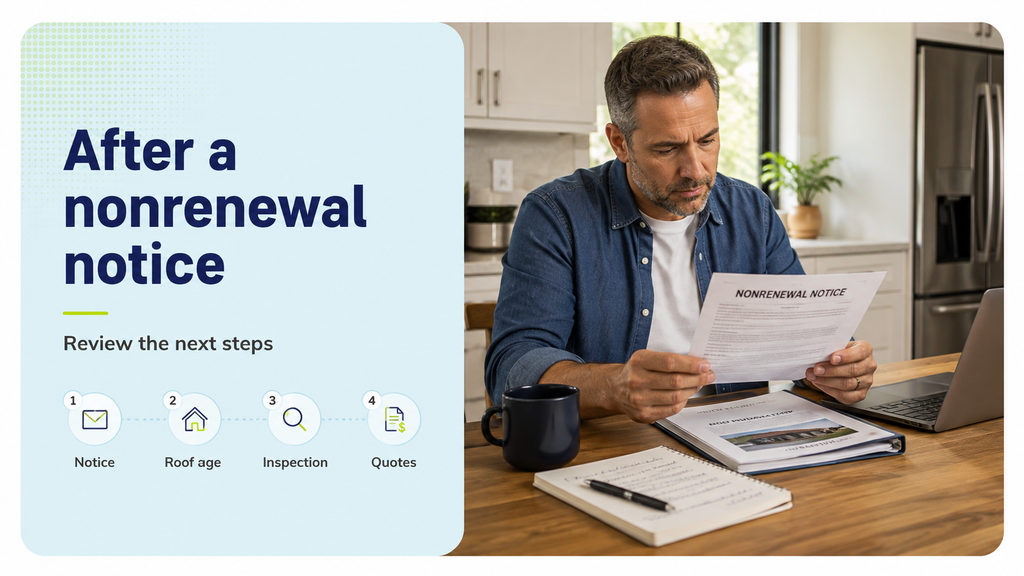
- Read the stated reason and effective date. Identify whether the insurer specifically cites roof age, roof condition, unrepaired damage or another underwriting issue.
- Confirm the roof’s documented age. Check permits, closing documents, contractor invoices and previous inspection reports. Don’t assume the insurer’s date is correct.
- Ask what would satisfy the insurer. If your roof is at least 15 years old, ask whether an authorized remaining-useful-life inspection can address the issue and what form the carrier requires.
- Confirm the inspector before paying for an inspection. Florida law defines authorized inspectors, but the inspector must also be approved by the insurer.
- Submit the report early. Don’t wait until days before expiration. Ask the insurer or agent to confirm receipt and state in writing whether additional conditions remain.
- Shop alternative coverage at the same time. Even if you expect the inspection to resolve the issue, comparing other available policies reduces the risk of reaching the expiration date without coverage.
- Plan replacement only if it makes sense for the roof and insurance situation. If the roof genuinely needs replacement, get a written scope of work, contractor price and financing information before signing.
If you believe an insurer’s decision conflicts with Florida insurance requirements and you can’t resolve the issue through the carrier or agent, the Florida Department of Financial Services provides consumer insurance assistance.
When an old roof actually needs replacement
The insurance deadline and the physical condition of the roof are related issues, but they aren’t identical.
A homeowner might have a 16-year-old roof that an authorized inspector believes has significant useful life remaining. Another home might have a younger roof with leaks, storm damage or deterioration that requires attention regardless of its age.
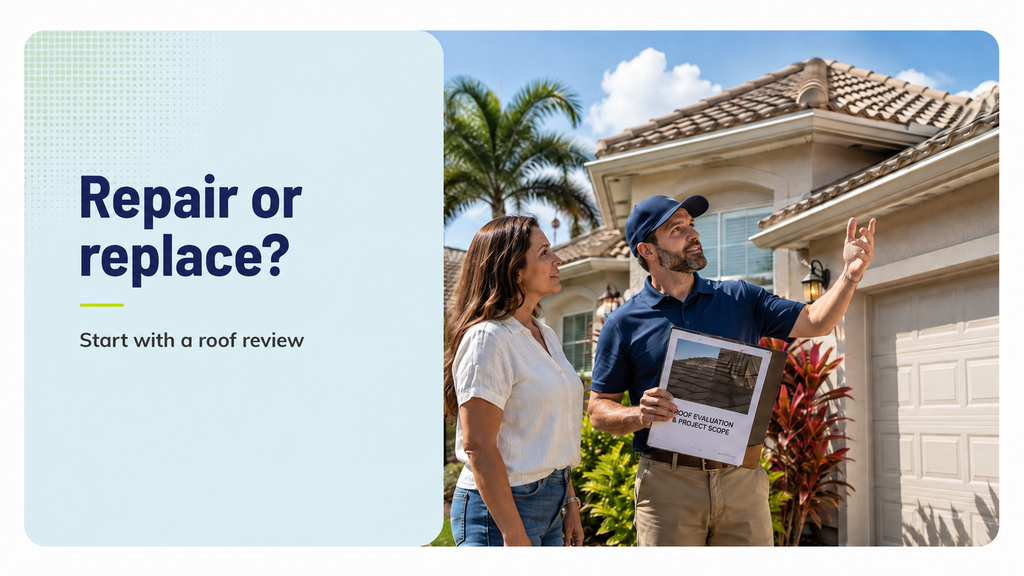
A roofing contractor can evaluate the physical work that may be necessary. Your insurer determines whether the completed work satisfies its underwriting requirements. Those are separate decisions.
Before accepting a replacement proposal, ask the contractor to document:
- The current roof condition and areas of concern
- Whether repair or full replacement is being recommended
- The roofing system and materials proposed
- Permit responsibilities and applicable code requirements
- The complete contract price and payment schedule
- Product and workmanship warranty terms
- What documentation you’ll receive after completion
You should also ask your insurance agent or carrier what records it will need after the project. That may prevent a situation where you finish expensive work but still lack documentation needed for underwriting.
A hypothetical example
Consider a Florida homeowner who receives a nonrenewal notice because the insurer’s records show a 17-year-old roof.
The homeowner first confirms that age is the stated concern. Instead of immediately authorizing replacement, the homeowner asks which roof inspection the carrier accepts. An authorized inspector determines that the roof has at least five years of remaining useful life and the homeowner submits the report before the carrier’s deadline.
Under Florida Statute 627.7011, the insurer can’t refuse to issue or renew the homeowners policy solely because of roof age when that inspection establishes at least five years of useful life. The carrier could still identify another lawful underwriting reason, so the homeowner should wait for written confirmation of the final coverage decision.
Now change one fact. Suppose the inspection identifies substantial deterioration and the homeowner decides replacement is necessary.
The problem has moved beyond the 15-year rule. The homeowner now needs to compare roofing bids, insurance requirements and ways to pay for the work.
Paying for a roof replacement if insurance timing is tight
A required roof replacement can create a difficult timing problem when the work needs to be completed before an insurance renewal deadline.
Start with the project cost, not the financing offer. Get a detailed written roofing proposal and understand exactly what work is included.
Then compare funding methods available to you. Cash avoids financing charges but requires enough liquid savings. Personal loans and home-equity products have their own rates, qualification standards, payment structures and potential property implications.
For eligible Florida homeowners, PACE may be another option.
Ygrene currently includes roof installation and repair among its PACE-eligible projects in Florida. The current project list also includes certain wind-resistant roofing and roof-strengthening improvements. Eligibility depends on the property, improvement and applicable program requirements.
How Ygrene PACE financing differs from a conventional loan
Property Assessed Clean Energy (PACE) financing is structured as a property assessment rather than a conventional personal loan.
Ygrene explains in its guide to how PACE financing works that residential PACE financing is repaid through property taxes and secured by the improved property.
The contractor performs the roofing work. Ygrene provides the PACE financing and doesn’t perform the construction itself.
Before treating PACE as an option, check whether your property is located within a participating jurisdiction. Ygrene’s Florida service-area information can help homeowners confirm where the program is currently available.

Review the property assessment carefully
PACE creates obligations that differ from a regular monthly consumer loan.
Ygrene states that PACE financing is secured through a recorded property lien and repaid through property taxes. If property taxes are paid through mortgage escrow, the assessment may become part of the amount collected through the mortgage payment.
Ygrene also advises homeowners that a PACE assessment can affect a future sale or refinance. Its PACE financing FAQs provide additional information about repayment, property transfers and other common homeowner questions.
Before signing, review the:
- Total assessment amount and project cost
- Interest rate, finance charges and repayment term
- Estimated property-tax payment
- Timing of the first assessment payment
- Effect on mortgage escrow, if applicable
- Early-payoff provisions
- Possible sale or refinance implications
- Contractor agreement and project scope
Ygrene’s consumer protection information explains the disclosures and financing information homeowners should review before entering into a PACE assessment.
PACE financing won’t make sense for every homeowner. Compare its total cost and property-related obligations with cash, home-equity financing, personal loans or other options available to you. Speak with your mortgage lender, insurance professional, financial adviser, tax professional or attorney when your individual circumstances require specialized guidance.
Check your roof, coverage and financing options before the deadline
An older roof doesn’t automatically mean a Florida insurer can refuse to renew your homeowners policy solely because of age.
If your roof is under 15 years old, Florida law restricts age-only refusal to issue or renew. Once the roof reaches 15 years, you may be able to use an authorized inspection to establish that it has at least five years of useful life remaining. Other lawful underwriting issues can still affect coverage.
If replacement is genuinely needed, don’t let the insurance deadline push you into an agreement you haven’t reviewed. Confirm the insurer’s requirements, compare contractors and understand the complete cost of any financing.
Florida homeowners considering an eligible roof project can review Ygrene’s PACE financing options and confirm whether their property and proposed improvement qualify before deciding how to pay for the work. Eligibility and financing terms vary, so review all disclosures and property-tax obligations before proceeding.
FAQs
Can a Florida insurer nonrenew my policy because my roof is over 15 years old?
Not solely because the roof has reached 15 years. Florida law requires an insurer to allow an authorized inspection before requiring replacement based on age and prevents an age-only refusal to issue or renew if that inspection finds at least five years of useful life remaining. Other lawful underwriting reasons may still support a nonrenewal.
Does Florida require every roof to be replaced after 15 years?
No. The 15-year threshold is part of an insurance rule, not a statewide requirement that every roof be replaced at that age. For roofs at least 15 years old, inspection results can determine whether roof age alone may be used in an issuing or renewal decision.
Who pays for a 15-year roof inspection in Florida?
The homeowner pays for the inspection contemplated by Section 627.7011. Before scheduling one, ask the insurer which inspectors and documentation it will accept.
What happens if my roof inspection shows less than five years of useful life?
The specific age-based protection tied to five or more remaining years wouldn’t apply in the same way. Ask the insurer what work it requires, whether repair could satisfy its underwriting standards and what deadline applies before committing to a replacement.
Is a nonrenewal the same as an insurance cancellation?
No. A nonrenewal means the insurer doesn’t continue the policy after its normal expiration date. A cancellation ends coverage before the policy’s scheduled expiration and different rules can apply.
Can replacing my roof guarantee that my insurer will renew the policy?
No. A new roof may resolve a roof-related underwriting concern, but it doesn’t guarantee renewal, a particular premium or acceptance by a specific insurer. Confirm the carrier’s requirements before beginning the project and ask what completion documents it needs.
Can Ygrene PACE financing be used for a Florida roof replacement?
Roof installation and repair currently appear among Ygrene’s eligible Florida PACE projects. Your property must also satisfy applicable service-area, project and program requirements, so a qualifying project category doesn’t guarantee financing approval.