
PACE financing works differently from a personal loan or home equity product. It finances qualifying property improvements through a voluntary assessment that is repaid with the property tax bill and a first-priority lien for the total amount financed is placed on the property as collateral.
This guide explains where Ygrene is currently available in Miami-Dade County, which projects may qualify, how the assessment works and what homeowners should review before signing. It is intended as general education for homeowners comparing ways to pay for major repairs or upgrades.
Is PACE financing available in Miami-Dade County?
Yes. Ygrene currently lists Miami-Dade County among its Florida service areas, with eligible areas that include municipalities and unincorporated communities.
That does not mean every property in the county automatically qualifies. Residential PACE programs operate only where the relevant county or municipality has authorized them. Florida law requires authorization before a program administrator may offer residential PACE financing in a jurisdiction.
Miami-Dade County also explains that PACE is available in unincorporated Miami-Dade for qualifying improvements. The County authorizes participating PACE programs but does not itself administer the financing. Property owners enter into agreements with PACE program administrators rather than with Miami-Dade County.
For homeowners, the practical first step is to check the exact property rather than assuming eligibility based on a Miami-Dade mailing address. Ygrene’s Florida PACE service areas provide the most relevant starting point for checking whether the program is currently offered in a particular area.
The Miami-Dade County sustainable property improvement information page also provides county-level information about how PACE operates locally.
What the PACE program, available in Miami-Dade, actually is
Property Assessed Clean Energy, or PACE, is a financing structure for certain permanent property improvements. It is not a government program, grant, rebate or subsidy.
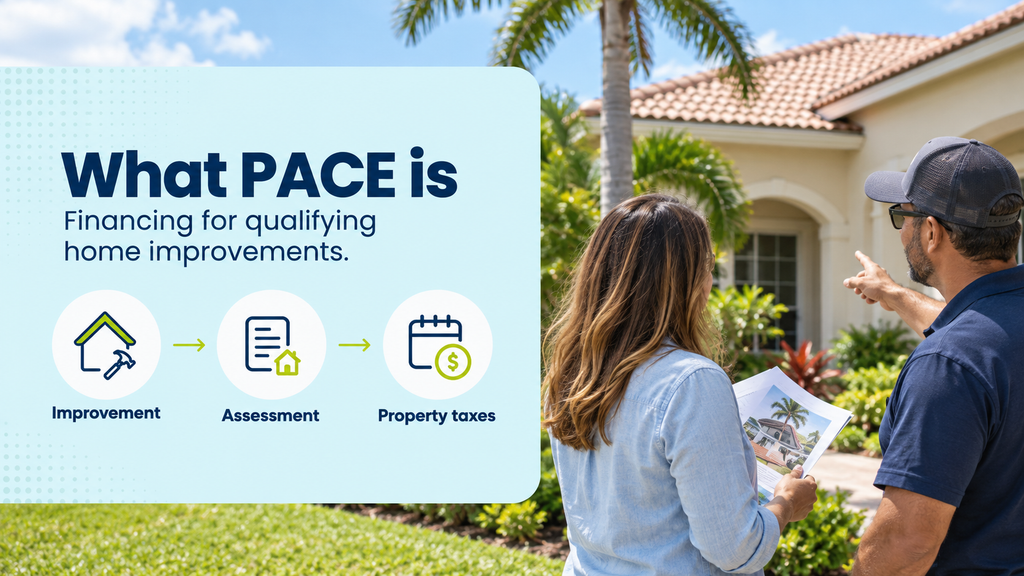
With residential PACE, the financed amount becomes a voluntary non-ad valorem assessment associated with the property. Repayment is collected with property taxes and the financing is secured by a recorded first-priority lien on the property.
Miami-Dade explains that property owners receive upfront financing for eligible improvements and repay the obligation through voluntary assessments on their property tax bills. The County also makes clear that participating PACE providers are private entities rather than county agencies.
That distinction matters when comparing PACE with other ways to finance a roof, impact windows or another large project. The structure, qualification criteria and repayment process differ from those of a conventional consumer loan.
How Ygrene PACE financing works in Miami-Dade
The process begins with confirming that both the property and proposed improvement are eligible. If they are, the homeowner can apply for financing, review the project and financing documents, have a contractor complete the approved work and repay the resulting assessment through the property-tax system.
Ygrene’s guide to how PACE financing works explains the current process from eligibility and project approval through completion and repayment.
Approval is based on more than the address
Being in an eligible Miami-Dade jurisdiction is only one part of qualification.
Florida law establishes residential underwriting requirements that address the property’s financial status and the owner’s ability to pay. These requirements include factors related to mortgage and property-tax payment history, equity in the owner’s property, certain liens, bankruptcy history, reverse mortgages, income verification and the relationship between the annual PACE obligation and household income.
The current requirements appear in Florida Statute 163.081, which governs residential PACE financing agreements and consumer protections.
Ygrene states that residential approval considers factors such as home equity and income rather than relying on a credit score as the basis for approval. Its current FAQ also explains that a soft credit pull may be used to verify certain eligibility information.
This doesn’t mean financial circumstances are irrelevant. Property eligibility, income, equity and other applicable underwriting requirements still matter.
The project must also qualify
PACE isn’t general-purpose cash financing. Funds must be used for qualifying permanent improvements to the property.
Florida’s PACE statutes cover categories that can include:
- Qualifying roof repair, replacement and strengthening work
- Certain heating, cooling, ventilation and energy-efficiency improvements
- Renewable-energy improvements
- Water-conservation improvements
- Certain sewer and onsite sewage system improvements
- Qualifying windows, doors and other property improvements that meet applicable program requirements
Homeowners can compare the planned scope of work with Ygrene’s current eligible PACE projects before treating PACE as a financing option.
A qualifying category doesn’t mean every product, repair or scope of work automatically qualifies. The actual property and proposed improvement still need to meet current program requirements.
The contractor performs the work
Ygrene provides financing. The contractor performs the installation or construction.
Florida law requires contractors participating in residential PACE programs to hold the licenses or registrations required for the work they perform. Program administrators must also maintain processes related to contractor registration and participation.
Homeowners still need to review the contractor agreement independently. That means checking the scope of work, equipment or materials, warranties, permits, change-order terms, project price and responsibility for correcting defects.
Financing approval should not be treated as an endorsement of a contractor’s workmanship or pricing.
What can PACE financing cover in Miami-Dade?
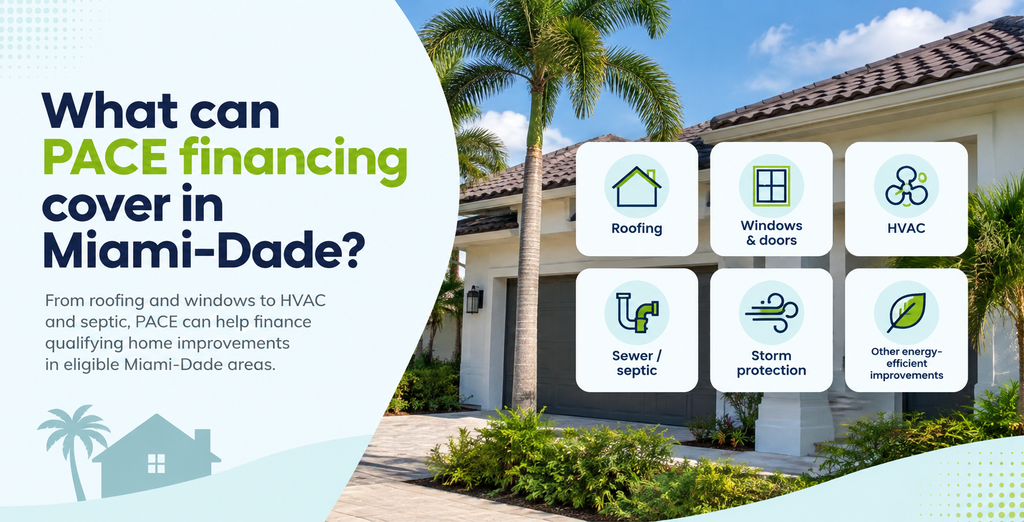
Miami-Dade homeowners may encounter several PACE-eligible project categories when planning substantial property work. Examples can include roof replacement, qualifying windows or doors, HVAC improvements and certain septic or sewer projects.
The key is to start with the property need rather than the financing product.
For example, suppose a homeowner in an eligible part of Miami-Dade has a roof approaching the end of its useful life. The homeowner receives contractor estimates and confirms that the proposed replacement falls within an eligible PACE category.
PACE could then be compared with cash, a home-equity product, personal financing or another available funding method. The homeowner would need to compare the complete obligations rather than looking only at the size of a periodic payment.
That includes the project price, amount financed, rate, fees, repayment term, total repayment obligation and possible consequences if the property is sold or refinanced before the assessment is paid off.
Common Miami-Dade project scenarios
A few hypothetical examples show where in the planning process a property owner in Miami Dade may consider PACE.
Roof replacement: A homeowner needs a qualifying roof replacement but doesn’t want to pay the full contractor invoice upfront. PACE may be one financing option if the property, owner and project meet applicable requirements.
Impact windows or doors: A homeowner planning qualifying wind-resistance improvements may check whether the specific project falls within an eligible category. Any possible insurance discount should be verified separately with the insurer because financing eligibility doesn’t guarantee an insurance benefit.
HVAC replacement: An older air-conditioning system may qualify under an energy-efficiency category depending on the equipment and program requirements. The homeowner should still compare the contractor’s complete installed cost before financing it.
Septic or sewer work: Florida’s PACE framework includes certain wastewater-related improvements. Specific eligibility and procedural requirements can vary, so the homeowner should confirm the current rules for the proposed project.
How repayment affects your property tax bill
PACE repayment deserves particular attention because this is where the structure differs most visibly from conventional consumer financing.
Ygrene explains that the PACE obligation is repaid through an assessment included with property taxes. If property taxes are paid through a mortgage escrow account, the mortgage servicer may collect the amount needed to cover the assessment along with the other escrowed property-tax obligations.
Miami-Dade County also explains that a PACE assessment increases the annual property-tax obligation. For homeowners whose property taxes are escrowed, this can affect the amount collected through the mortgage payment.
A homeowner should therefore convert the annual assessment into a household-budget figure before signing. Looking only at an annual number can make it harder to understand how the obligation may affect monthly cash flow when taxes are escrowed.
What to review in the financing disclosure
Florida law requires residential PACE consumers to receive financing estimates and disclosures before entering into an agreement. The disclosures address financial information such as the amount financed, project cost, program fees, estimated annual assessment, financing term and interest-related charges.
The law also addresses sale or refinance considerations, the property lien, cancellation rights and other material obligations.
Before signing, homeowners should also review Ygrene’s consumer protection information alongside the actual financing agreement and contractor documents.
| Item to review | Why it matters |
| Contractor project price | This establishes what the improvement itself costs before financing. |
| Total amount financed | This shows how much will actually become part of the financed obligation. |
| Interest rate and APR | These help show the cost of financing over time. |
| Program fees and finance charges | These can increase the amount ultimately repaid. |
| Annual PACE assessment | This is the amount added to the property-tax obligation. |
| Repayment term | A longer term can reduce periodic payments while extending how long interest accrues. |
| First assessment date | This helps with budgeting and escrow planning. |
| Early-payoff terms | These matter if you expect to sell, refinance or pay off the assessment early. |
| Sale and refinance provisions | Mortgage requirements may affect whether the remaining balance must be paid off. |
Reading these figures together provides a more useful picture than focusing on a single payment estimate.
What Miami-Dade homeowners should check before choosing PACE
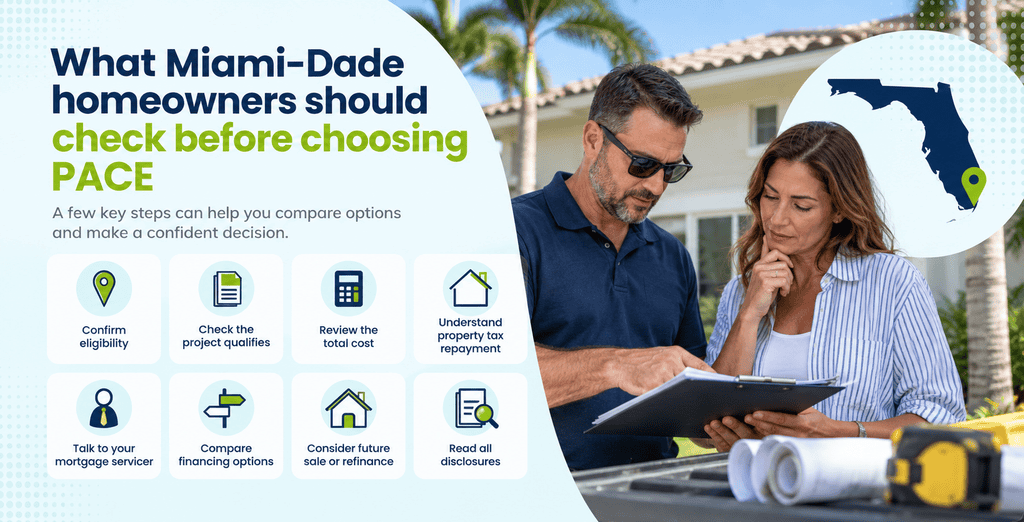
A practical comparison can be completed in a clear sequence. Each step answers a different question and helps keep the contractor decision separate from the financing decision.
1. Confirm the property is in an eligible jurisdiction
Start with the exact property address.
PACE participation is jurisdiction specific, so a Miami-Dade address alone doesn’t establish that Ygrene financing is currently available for a particular property.
2. Confirm that the planned improvement qualifies
Compare the contractor’s actual proposed scope with current PACE eligibility requirements.
Don’t rely on a broad description such as “windows” or “roofing.” Confirm that the specific permanent improvement falls within an eligible category.
3. Separate the project price from the financing decision
Request an itemized contractor proposal before comparing financing.
Current Florida law also includes consumer-protection requirements related to contractor estimates for higher-cost residential PACE projects. Reviewing competing estimates can help homeowners judge the cost of the improvement independently from the financing attached to it.
4. Compare total obligations rather than payment size
A longer repayment period can reduce the size of an individual payment while increasing the length of time interest accrues.
Compare:
- The contractor’s project price
- The amount financed after applicable fees
- The interest rate and APR
- The annual assessment
- The full repayment term
- The estimated total repayment
- Early-payoff terms
If comparing PACE with a home-equity loan, home equity line of credit or personal loan, use actual offers available to you rather than representative rates shown in advertising.
5. Ask your mortgage servicer about escrow
If your mortgage payment includes an escrow account for taxes, ask the servicer how a PACE assessment could affect the amount collected.
The assessment may change the total property-tax obligation that the servicer needs to cover through escrow.
Knowing that impact before signing gives you a clearer picture of your future housing costs.
6. Consider your sale or refinance plans
PACE financing creates a property-related assessment secured by a lien. A future mortgage lender will most likely require the remaining PACE balance to be paid before approving a sale-related mortgage or refinance.
Florida law also requires disclosure of an outstanding residential PACE assessment to a prospective purchaser.
If you expect to move or refinance before the assessment term ends, review the payoff provisions and ask your mortgage professional how PACE could affect the transaction.
7. Read every disclosure before signing
Compare the written financing documents with the contractor proposal.
Confirm that the project cost, amount financed, fees, interest, annual assessment, repayment term and estimated first payment are consistent with what you were told.
Also review cancellation provisions, lien disclosures, payoff terms and the consequences of missed property-tax payments. For questions involving your own mortgage, taxes, legal obligations or finances, consider speaking with the appropriate licensed professional before making a decision.
PACE financing versus other ways to pay for a project in Miami-Dade
PACE may fit some homeowners and not others. The appropriate comparison depends on the project, available cash, credit profile, home equity, expected ownership period and future mortgage plans.
Cash avoids financing charges but requires sufficient liquid funds. Personal loans usually create a separate repayment obligation and generally involve borrower-based credit underwriting. Home-equity products use the homeowner’s equity and have their own qualification, closing and repayment requirements.
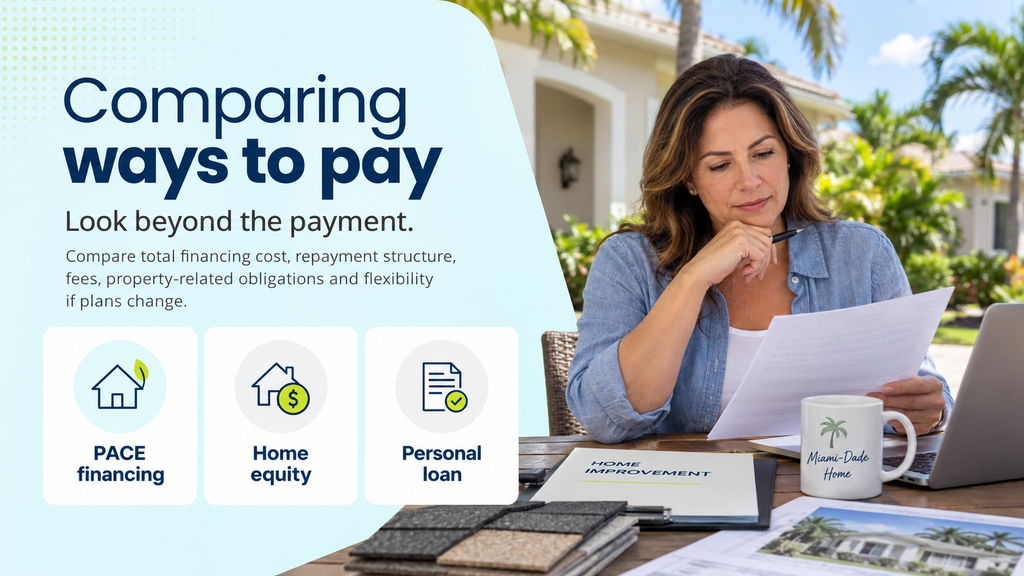
PACE is tied to an eligible property improvement and repaid through a property assessment. Its property-tax and lien structure are material differences, especially for homeowners who may sell or refinance.
For that reason, comparing only the lowest periodic payment can be misleading. Homeowners should compare total financing cost, repayment structure, fees, property-related obligations and flexibility if their plans change.
A Miami-Dade homeowner considering Ygrene financing should obtain the complete PACE disclosure and compare it with written terms for any realistic alternative.
Check your Miami-Dade property before comparing terms
PACE can give eligible Miami-Dade homeowners another way to finance qualifying property improvements, but the assessment should be evaluated with the same care as any significant long-term financial obligation.
Start by confirming that Ygrene currently serves your exact property and that the planned improvement qualifies. Then review the contractor price, financing amount, fees, rate, annual assessment, total repayment, escrow impact and sale or refinance provisions before deciding whether PACE fits your situation.
If the property and project appear eligible, the next step is to check your address with Ygrene and review the specific financing terms you receive before moving forward.
FAQs
Is Ygrene available throughout Miami-Dade County?
Ygrene currently lists eligible Miami-Dade service areas, but availability depends on the specific jurisdiction and property. Homeowners should check their exact address rather than assume that every Miami-Dade property qualifies.
Is PACE financing in Miami-Dade a regular loan?
No. PACE financing is structured as a voluntary property assessment rather than a conventional consumer loan. The obligation is associated with the property, repaid through the property-tax system, and a first-priority lien is placed on the property.
Does Ygrene check my credit score?
Ygrene states that its residential approval process doesn’t use a credit score as the basis for approval, although a soft credit inquiry may be used to verify certain information. Income, property equity and other program requirements can still affect eligibility.
Will PACE increase my Miami-Dade property tax bill?
Yes. The PACE assessment becomes part of the property’s tax-related obligation. If taxes are paid through mortgage escrow, the assessment can also affect the amount the servicer collects for escrow.
Can I use PACE financing for a roof or impact windows?
Potentially. Roofing and qualifying windows and doors can fall within eligible PACE improvement categories. The exact property, product and scope of work must still satisfy current program requirements.
What happens to PACE financing if I sell my home?
An outstanding assessment can affect a sale. Prospective buyers must receive required disclosure and a buyer’s mortgage lender will likely require the remaining PACE obligation to be paid off as part of the transaction.
Can I pay Ygrene PACE financing off early?
Ygrene provides information about early payoff in its current program materials. Homeowners should review their own financing agreement and request a current payoff amount because the applicable terms are determined by the actual agreement.