
Choosing how to pay for a major home repair can be almost as consequential as choosing the contractor. For Florida homeowners comparing PACE vs personal loan financing or an offer arranged by a contractor, the options differ in more than the payment amount.
This guide compares how each option works, what you should examine in the financing documents and how property taxes, credit, project eligibility and future plans for the home can affect the decision. It is general educational information, not individualized financial, tax or legal advice.
How the three home repair financing options work
A roof replacement, impact-window project or failing HVAC system can create a large expense without much warning. Several financing paths may cover the same contractor invoice, but they can create very different obligations.
The first useful distinction is where the debt or assessment sits and how you repay it.
PACE financing
Property Assessed Clean Energy, or PACE, financing pays for eligible improvements to real property. In Florida, residential PACE repayment is made through a non-ad valorem assessment associated with the property rather than a conventional monthly personal-loan payment. A first-priority lien for the total amount financed will be placed on the property as collateral. PACE is not a government sponsored program and there is no government assistance available to pay the assessment.”
Under Florida’s residential PACE statute, a program administrator may offer residential PACE financing within a county or municipality only when the local government has authorized the program. The law also sets requirements for financing agreements, property-owner eligibility, disclosures and repayment.
Ygrene provides PACE financing for Florida homeowners for qualifying property improvements. Availability and eligibility depend on the property, improvement and applicable program requirements.
A key difference is that PACE creates an assessment connected to the property. Florida law requires the recorded agreement to provide notice that the assessment constitutes a lien with the status described in the statute. The assessment is collected with property taxes.
Personal loans
A personal installment loan is conventional consumer credit made to the borrower. Depending on the lender, approval and pricing may consider your credit history, income, existing debts, requested amount and loan term.
The Consumer Financial Protection Bureau’s guidance on personal installment loans explains that these loans are generally repaid in set installments over a specified period. Lenders may consider credit reports, income, debts, the requested loan amount and other financial information when setting terms.
Many personal loans are unsecured, meaning you aren’t pledging the house directly as collateral. That doesn’t make the debt consequence-free. Missed payments may still result in collection activity and credit reporting.
Contractor financing
“Contractor financing” describes how financing is offered rather than one standardized type of credit.
A roofer, window installer, HVAC company or other contractor may work with a third-party lender that allows the homeowner to apply during the sales process. The underlying product could be an installment loan, promotional financing or another form of consumer credit.
That means two contractors can both advertise financing while offering very different rates, terms and fees. You need to review the actual lender agreement rather than evaluating the offer based only on the contractor’s monthly-payment quote.
The Federal Trade Commission’s home improvement guidance recommends shopping around and comparing loan terms rather than accepting financing solely because a contractor arranged it. It also advises homeowners to read financing documents carefully before signing.
PACE vs personal loan vs contractor financing at a glance
There isn’t one financing structure that will be preferable for every homeowner. The useful comparison is how each option affects your property, cash flow, credit and total obligation.
| Factor | PACE financing | Personal loan | Contractor financing |
| What is financed? | Eligible property improvements | Generally flexible consumer borrowing | Usually the contractor’s specific project |
| How is it repaid? | Through a property-related non-ad valorem assessment | Periodic payments to the lender | Depends on the underlying financing agreement |
| Is it tied to the property? | Yes, through the assessment and recorded lien | Usually not if the personal loan is unsecured | Depends on the product offered |
| Is credit relevant? | Florida PACE has statutory eligibility and ability-to-repay requirements | Credit commonly affects approval and pricing | Depends on the lender and product |
| Can every repair qualify? | No. The project must meet program requirements | Loan proceeds may be more flexible, subject to lender terms | Usually limited to work being sold by that contractor |
| What happens when you sell? | The unpaid assessment requires special attention and a mortgage lender will most likley require payoff | Loan generally remains the borrower’s obligation | Depends on the credit agreement |
| What should you compare closely? | Assessment, term, APR, fees, property impact and sale or refinance provisions | APR, fees, term, payment and total repayment | APR, promotional terms, fees, payment and lender conditions |
The table is a starting point. Your written disclosure documents should control your decision because individual offers can differ substantially.
What matters most in a PACE vs personal loan comparison
Looking only at “what will I pay each month?” can hide the most important differences.
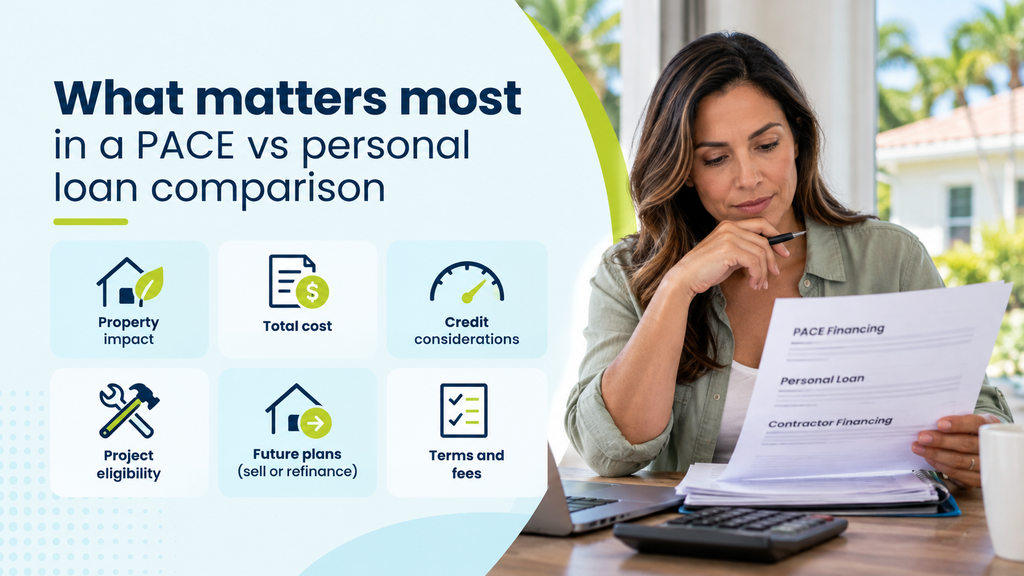
For Florida homeowners, a better comparison considers six factors.
1. Where the repayment obligation sits
With a personal loan, the borrower owes a lender under a credit agreement. If the loan is unsecured, repayment isn’t collected through the home’s property tax bill.
PACE uses a different structure. Florida law permits repayment through a non-ad valorem assessment and requires disclosure that the assessment will be collected with property taxes and result in a lien on the property after the agreement is recorded. PACE is not a government sponsored program.
That distinction matters when you think about future mortgage transactions or a sale.
Florida’s residential PACE statute also requires disclosures addressing what may happen to an outstanding assessment when the homeowner sells or refinances. A mortgage lender require the remaining amount to be paid off as part of a future transaction.
Don’t assume either that the assessment automatically transfers or that it always must be paid off. Ask specifically what would happen with your financing, mortgage lender and intended transaction.
2. Whether the project qualifies
A personal loan may give a homeowner broad discretion over how borrowed funds are used, subject to the lender’s terms.
Residential PACE is narrower because the project must meet the statutory and program definition of a qualifying improvement.
Florida’s broader PACE enabling statute and qualifying-improvement definitions cover categories that can include:
- Certain roof repairs, replacements and wind-resistance improvements
- Energy-efficient, impact-resistant or hurricane-resistant windows and doors
- Storm shutters
- Eligible heating, cooling and ventilation systems
- Insulation and qualifying water heaters
- Permanent generators
- Certain flood mitigation and resiliency work
- Qualifying sewer and septic improvements
- Renewable-energy improvements
The complete statutory definition matters because merely calling work a “home improvement” doesn’t make it PACE eligible.
Homeowners who want a simpler overview of common program questions can also review Ygrene’s PACE frequently asked questions.
3. How qualification is evaluated
Traditional personal lenders commonly consider the applicant’s credit, income, outstanding debts and related borrower information when deciding whether to lend and at what price.
Florida residential PACE uses statutory eligibility requirements that focus on both the property and the owner’s ability to meet the obligation. Among other requirements, the program administrator reviews property-related payment history, existing obligations and information supporting the owner’s ability to repay.
These are different underwriting structures. A homeowner who qualifies for one option shouldn’t assume the same result, amount or terms will apply to another.
4. The term and total cost
A smaller periodic payment can result from spreading repayment over more years. That can help cash flow, but it doesn’t tell you what the financing ultimately costs.
For any home repair financing option, compare:
- The amount actually being financed
- The stated interest rate
- The annual percentage rate, or APR, when applicable
- Origination, program or other financing fees
- The repayment period
- The total scheduled repayment
- Any early payoff conditions
The CFPB explains in its guidance on interest rates and APR that an interest rate represents the cost of borrowing while APR also accounts for certain additional loan charges. When APR disclosures are available for the products you’re comparing, they can provide a more consistent basis for evaluating borrowing costs.
Florida’s residential PACE law also requires written disclosures covering important financing terms before the agreement is completed. Review those disclosures rather than relying on an advertised payment amount.
5. How soon you may sell or refinance
Suppose you expect to stay in your home for 15 years. A longer repayment structure may look very different from the same financing considered by someone expecting to move in two years.
With a conventional personal loan, selling the home generally doesn’t eliminate the borrower’s personal debt. You continue repaying according to the loan agreement unless you pay it off.
PACE needs a different review because of its relationship to the property. If you think a move, refinance or new home-equity transaction is likely during the financing term, ask how the outstanding assessment would be handled before signing.
Contractor financing comparison: questions the payment quote doesn’t answer
A contractor may say, “We can get this down to $250 a month.”
That number isn’t enough to evaluate the deal.
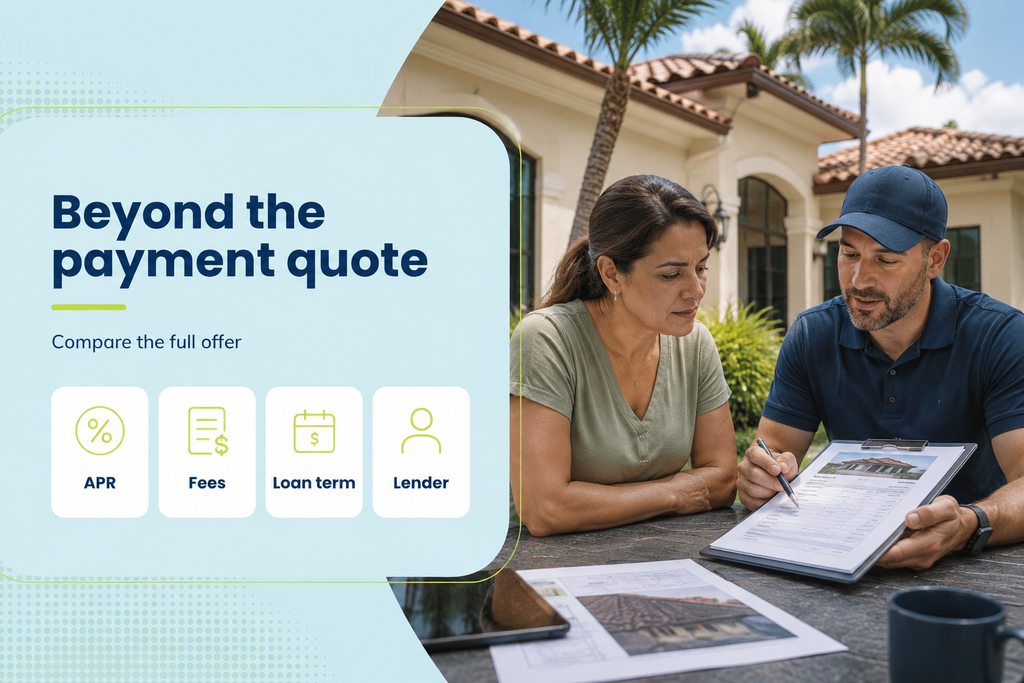
A useful contractor financing comparison starts with the underlying agreement. Ask:
- Who is the lender? Get the legal name of the financing company rather than relying on the contractor’s branding.
- What is the APR? Don’t compare one offer’s APR with another offer’s simple interest rate.
- How long is the repayment term? A lower payment may simply reflect more years of repayment.
- Are there origination or other fees? Determine whether fees are paid upfront or added to the financed balance.
- Is the advertised rate temporary? If there is a promotional period, identify what happens when it expires.
- When does the contractor get paid? Understand whether funds are released before, during or after project completion.
- Can you repay early? Read the agreement for any payoff procedure or applicable restrictions.
The financing quote shouldn’t prevent you from checking whether the construction price itself is competitive. Get multiple written estimates and compare the scope of work as carefully as the financing.
A hypothetical Florida home repair example
Consider a Florida homeowner who needs a roof replacement before the existing roof deteriorates further.
The contractor provides a cash project price and offers financing through a third-party lender. The homeowner also qualifies to explore PACE because certain roofing improvements can fall within Florida’s statutory list of qualifying projects.
A personal lender provides a third quote.
At first glance, the three options might appear easy to rank by periodic payment. That would leave several important questions unanswered.
For the personal loan, the homeowner should calculate the loan’s APR, fees, total repayment and effect on monthly cash flow.
For the contractor offer, the homeowner should determine whether the project price is identical to the cash price, identify the actual lender and check whether any promotional terms change later.
For PACE, the homeowner should examine the assessment amount, full amount financed, program fees, repayment term and the effect on the property’s tax obligation. Because the homeowner may refinance within several years, the sale and refinancing disclosures deserve particular attention.
The appropriate choice could change if the homeowner expects to sell soon, has limited monthly cash flow, receives materially different financing costs or doesn’t qualify for one of the alternatives.
That’s why comparing the payment alone doesn’t resolve the decision.
How Florida PACE protections affect the comparison
Florida’s residential PACE framework includes specific requirements that homeowners should understand when comparing PACE with other home repair financing options.
Before entering a residential financing agreement, the program administrator must make findings required by state law and provide specified disclosures. These address matters such as the amount financed, repayment obligations, property-related consequences and cancellation rights.
Florida law also requires a recorded oral verification call before the financing agreement is completed. The statutory framework gives residential property owners a three-business-day period to cancel the financing agreement without financial penalty.
Contractor oversight is also part of Florida’s PACE framework. Participating contractors are subject to licensing or registration requirements and program administrators have compliance responsibilities related to participating contractors.
These protections don’t eliminate the need to compare alternatives. They give homeowners information and defined procedures that should be reviewed alongside the terms of any personal loan or contractor-arranged financing offer.
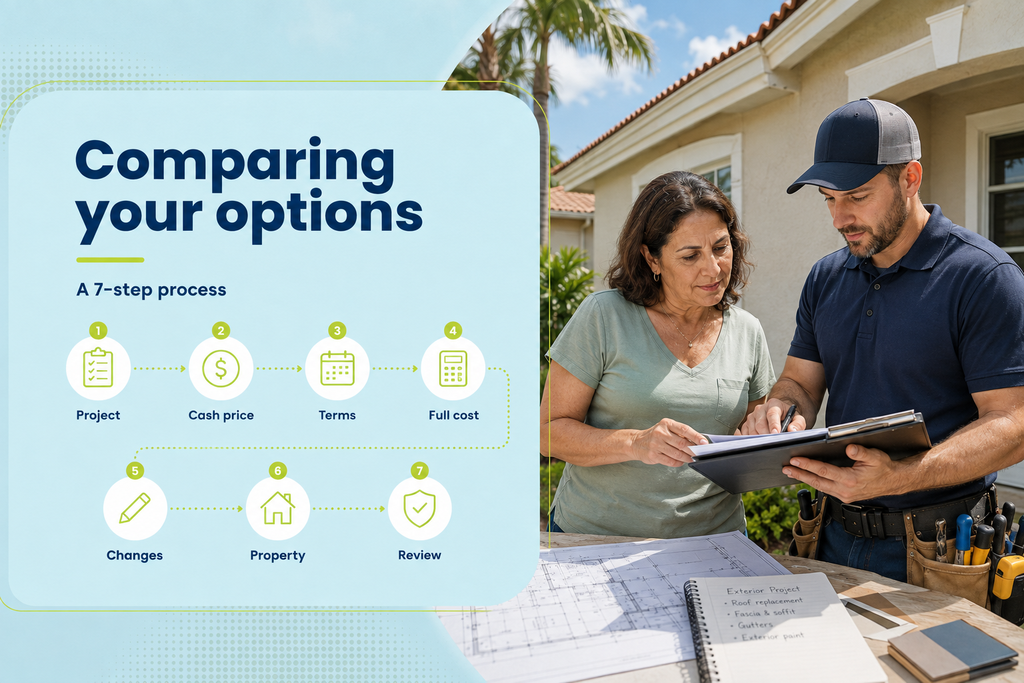
A seven-step process for comparing home repair financing options
Before financing a major repair, work through the options in the same order so one attractive number doesn’t dominate the decision.
1. Define the project before discussing financing
Get a written scope covering materials, labor, permits and expected project stages. Financing a vague estimate makes it difficult to know whether the amount borrowed reflects the final work.
For larger projects, getting more than one independent contractor estimate also helps you separate the cost of the work from the financing attached to a particular contractor.
2. Get the cash price
Ask what the project would cost without financing.
This separates the construction decision from the borrowing decision and gives you a baseline for identifying whether a financing arrangement affects the quoted project cost.
3. Collect complete financing disclosures
Don’t compare verbal quotes.
For each option, obtain the written rate, APR where applicable, financed amount, fees, payment schedule, term and total repayment information available in the disclosure.
4. Put every offer on the same time horizon
A five-year personal loan and a financing structure repaid over a much longer term shouldn’t be compared only by payment size.
Look at what each would cost if carried according to its scheduled term. Then consider what could happen if you pay it off earlier because you sell, refinance or receive additional cash.
5. Identify what happens when circumstances change
Ask what happens if:
- You sell the home.
- You refinance the mortgage.
- You want to repay early.
- The project cost changes.
- The contractor doesn’t finish the work as expected.
- Your household income falls.
- Your property-tax escrow payment changes.
These questions expose differences that a rate comparison may miss.
6. Review the property impact separately
For PACE, understand the assessment, lien and property-tax implications.
For any home-secured financing alternative, understand the security interest and default provisions in its own documents.
For an unsecured personal loan, understand the credit-reporting, collections and default provisions.
7. Have the documents reviewed when the stakes justify it
A large roof, storm-hardening or whole-home project can create a long financial obligation. Consider discussing tax questions with a tax professional, contract questions with an attorney and budget implications with a qualified financial professional.
The financing provider can explain its product, but independent professional advice can help you evaluate how the agreement fits your particular circumstances.
When each financing option may deserve a closer look
None of these choices is automatically the right answer.
PACE may deserve consideration when the property and improvement qualify, the homeowner understands the assessment structure and a property-based repayment approach fits the household’s plans.
A personal loan may be worth comparing when you want conventional borrower-based financing, prefer an obligation separate from the property-tax assessment or receive competitive terms based on your financial profile.
Contractor financing may be convenient when the underlying lender provides competitive terms and the contractor’s project price also compares well with other bids. Convenience should be treated as one factor rather than the deciding factor.
In many cases, the best next step isn’t to pick a category first. Get actual written offers and compare their full obligations side by side.
Compare your financing before committing to the repair
A major Florida home repair often needs to move quickly, especially when roofing, storm protection, HVAC or another essential system is involved. Financing still deserves a separate decision from the construction contract.
If an eligible property improvement may qualify for PACE, you can contact Ygrene about your home improvement project to discuss the available financing path and the information needed to get started. Compare the written PACE terms with any personal-loan or contractor-financing offer before deciding how to fund the work.
FAQs
Is PACE the same as a personal loan?
No. A personal loan is consumer credit owed by the borrower under a loan agreement. Florida PACE financing is repaid through a non-ad valorem property assessment and creates a property-related obligation under the state’s PACE framework.
Does PACE financing affect my property taxes?
PACE repayment is collected through a non-ad valorem assessment associated with the property, so the amount due with the property tax bill can change. If your mortgage payment includes an escrow account, ask your mortgage servicer how the assessment may affect escrow collections.
Does a personal loan require good credit?
Personal lenders commonly consider credit history or scores along with income, debts, the requested amount and other information. Requirements and pricing vary by lender, so a homeowner may receive different offers from different institutions.
Is contractor financing cheaper than a personal loan?
Not necessarily. Contractor financing can use many different credit products, so compare the APR, fees, repayment term, project price and total amount paid with a personal-loan offer. The advertised periodic payment alone doesn’t establish which option costs less.
Can I sell a house that has PACE financing?
A sale may be possible, but an outstanding PACE assessment needs to be addressed as part of the transaction. Mortgage requirements can affect whether the remaining assessment must be paid off, so ask the financing provider, mortgage lender and closing professionals how your specific transaction would be handled.
What Florida home repairs can PACE financing cover?
Florida law identifies qualifying improvement categories that can include certain roofing work, impact-resistant windows and doors, HVAC equipment, storm protection, permanent generators and other eligible property improvements. The property, project and local program must still meet applicable requirements.
What should I compare before signing a home repair financing agreement?
Compare the cash project price, amount financed, APR or applicable financing rate, fees, repayment term, payment schedule and total repayment obligation. Also review what happens if you pay early, sell or refinance and how contractor payment and project completion are handled.