
When a Florida home needs a costly roof, HVAC system, impact windows or another major repair, financing can shape when the work gets done and what it costs over time. A PACE vs HELOC comparison is useful because both options involve your property, but they work very differently.
This guide explains those differences so Florida homeowners can compare qualification, repayment, rates, project restrictions and future property plans before choosing a financing path.
PACE vs HELOC: How the two financing options work
Property Assessed Clean Energy (PACE) financing, offered through companies like Ygrene, helps eligible property owners finance qualifying improvements and repay the financing through a property assessment. In Florida, state law allows qualifying residential improvements to include certain roofing, energy efficiency, renewable energy, water conservation, storm-resilience and sewer or septic work. A first-priority lien for the total amount financed will be placed on the property as collateral. PACE is not a governmental program.
A home equity line of credit, or HELOC, works differently. The Consumer Financial Protection Bureau explains that a HELOC is an open-end line of credit that allows a homeowner to borrow repeatedly against available home equity during the draw period.
That basic structural difference affects almost every part of the decision.
| Factor | PACE financing | HELOC |
| What you receive | Financing for qualifying property improvements | A reusable credit line up to an approved limit |
| Main use | Eligible improvements permitted by the applicable PACE program | Generally flexible, subject to lender terms |
| Repayment | Through a property assessment collected with property taxes | Payments made to the HELOC lender |
| Rate structure | Ygrene currently offers fixed rates, with available terms varying by service area and project | Usually variable, although some HELOCs offer fixed-rate conversion features |
| Qualification | Ygrene considers property equity, ability to repay and other underwriting requirements | Lender typically considers equity, income, credit and ability to repay |
| Credit inquiry | Ygrene states that it uses a soft credit pull to verify certain underwriting criteria | A lender generally reviews credit during underwriting |
| Access to funds | Connected to an approved qualifying project | Can generally be drawn repeatedly during the draw period |
| Property connection | Repaid through an assessment secured by the improved property | Secured by the home |
The comparison isn’t simply about which financing option produces the smaller payment. You also need to consider how much you’re financing, how long you’ll repay it, whether the rate can change and what could happen if you sell or refinance the property.
Where PACE and a HELOC differ most
PACE financing is tied to qualifying improvements
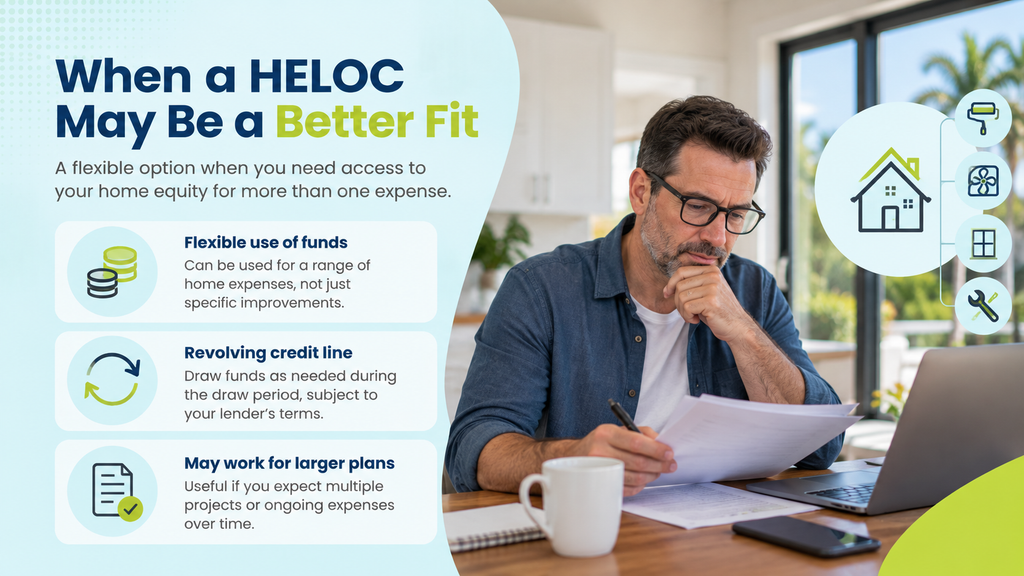
A HELOC may provide more flexibility in how borrowed funds are used. Once the credit line is established, the homeowner can generally draw against it during the draw period subject to the lender’s terms.
PACE financing has a narrower purpose. It finances improvements that qualify under the applicable Florida program and local authorization.
Florida’s current PACE statute identifies qualifying residential improvements such as roof repair or replacement, certain wind-resistance measures, energy-efficient heating and cooling, impact-resistant windows or doors, renewable energy improvements and qualifying sewer or septic work. Homeowners who want to review the statutory categories can refer to Florida Statute 163.08.
Ygrene maintains a more detailed list of currently eligible Florida PACE projects. Checking that list before applying matters because a project that doesn’t qualify for PACE may remove PACE from the comparison entirely.
The repayment method is fundamentally different
A HELOC creates a separate credit account. Depending on the lender and product structure, you typically make payments during the draw period and later enter a repayment period.
Most HELOCs have variable interest rates. This means the rate and required payment can change. The CFPB also explains that payments may increase after the draw period ends and the account enters repayment.
PACE financing follows a different repayment structure. Under Ygrene’s current program, the financing is repaid through the property’s tax bill. Homeowners whose property taxes are collected through mortgage escrow may see the assessment reflected in the amount their mortgage servicer collects.
Ygrene explains this repayment process in more detail on its page about how PACE financing works.
That distinction deserves close attention. A homeowner shouldn’t compare a HELOC’s quoted monthly payment with a PACE figure without putting both obligations on the same basis.
For PACE, review how the assessment could affect the total property-tax obligation and, where applicable, mortgage escrow. For a HELOC, review the expected payment during the draw period and what repayment could look like afterward.
HELOC rates are usually variable
One of the most important differences in a PACE financing comparison is the interest-rate structure.
According to the CFPB, HELOCs usually carry variable rates. A variable rate can move over time, so the payment can change even if the homeowner doesn’t borrow more. Some HELOCs allow part or all of the balance to be converted to a fixed rate under specified conditions.
Ygrene currently states that its PACE financing uses fixed rates. Available terms vary depending on the service area and type of improvement.
A fixed rate can make the financing rate more predictable, but it doesn’t automatically make PACE less expensive. A longer repayment period can increase total interest paid, so homeowners should compare total finance charges and total repayment rather than focusing only on the periodic payment.
Qualification works differently
A homeowner applying for a HELOC commonly encounters traditional lending criteria. Lenders may consider credit history, income, debt obligations, property value and available equity before deciding whether to approve the line and how much credit to offer.
PACE underwriting follows a different framework.
Ygrene currently states that approval is based on factors that include equity in the home and ability to repay. It also says that it uses a soft credit pull to verify certain underwriting criteria but doesn’t use the applicant’s credit score as the basis for qualification.
Florida law establishes additional requirements for residential PACE financing, including findings related to the property owner’s ability to pay and other statutory criteria.
Different underwriting doesn’t mean automatic approval. A Florida property owner still needs to meet the applicable program requirements and the proposed improvement must qualify.
When PACE may fit a Florida home repair better than a HELOC
Neither option is appropriate for every project or homeowner. PACE may be worth evaluating when the project qualifies, the property is within a participating jurisdiction and the homeowner prefers the specific repayment structure.
Consider a hypothetical homeowner in South Florida who needs to replace an aging roof.
The homeowner gets a complete contractor estimate and has enough equity in the property to investigate more than one financing option. They could apply for a HELOC, which may provide a reusable line of credit and flexibility if other expenses arise later.
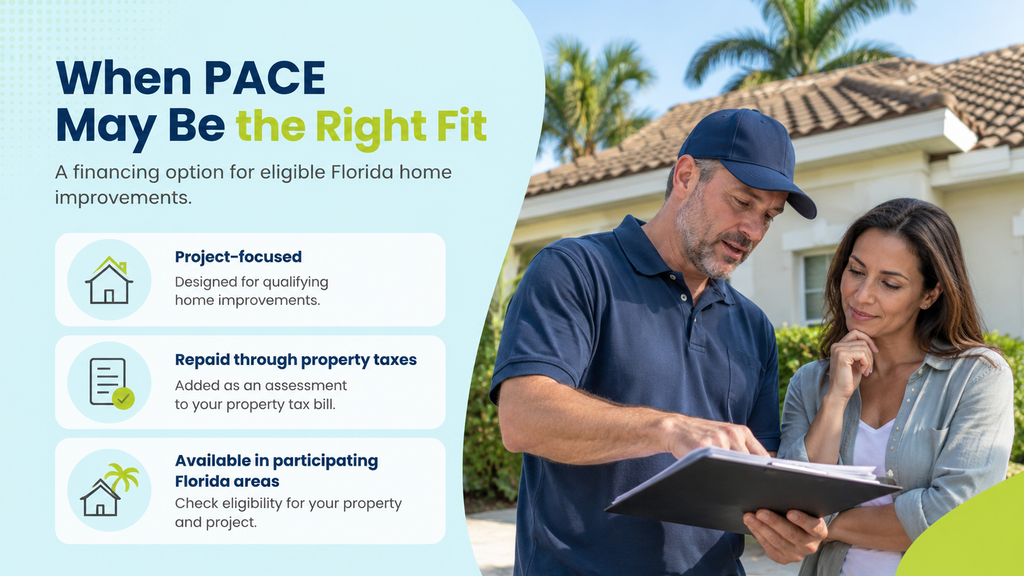
They could also investigate PACE because qualifying roof repair and replacement are included in Florida’s current residential PACE framework.
The homeowner’s decision should go beyond asking which application seems easier.
They would want to compare:
- The amount that actually needs to be financed after any available cash contribution.
- The interest rate and whether it can change.
- Every applicable origination, program, closing or finance charge.
- The payment schedule during the full financing period.
- The total amount expected to be repaid if the financing remains outstanding for its full term.
- The effect on property taxes, mortgage escrow, sale or refinancing.
- The process and cost of paying the obligation off early.
That exercise may lead two homeowners with identical repair costs to different decisions.
PACE can fit when the project, rather than access to cash, is the main need
PACE financing is designed around qualifying property improvements. It may be relevant when a homeowner has a defined project such as a roof, impact windows or qualifying HVAC work and wants financing tied directly to that improvement.
A HELOC offers broader borrowing flexibility. That can be useful when the homeowner expects several unrelated expenses or wants continued access to a line of credit after the immediate repair.
That flexibility also changes the borrowing decision. A homeowner approved for a larger HELOC limit doesn’t have to use the full amount, but access to additional credit isn’t the same as determining what the repair itself requires.
For a defined project, start with the contractor’s complete project price and compare financing based on the amount you actually expect to use.
PACE may be worth exploring when conventional credit qualification is difficult
Because HELOC underwriting usually takes the borrower’s credit profile into account, some homeowners may have substantial home equity but still have difficulty qualifying for the HELOC terms they want.
Ygrene states that it doesn’t require a minimum credit score and instead evaluates factors that include equity and ability to repay. It still performs a soft credit review to verify certain underwriting criteria.
That may make PACE another financing path to investigate for an eligible homeowner. It shouldn’t be interpreted as guaranteed approval or as a reason to overlook affordability.
The key question remains whether the complete PACE obligation makes sense for the homeowner’s finances, property and future plans.
When a HELOC may fit better than PACE financing
A HELOC can be a strong candidate when a homeowner qualifies for competitive terms and values flexible access to home equity.
You expect to fund more than one expense
PACE financing must be connected to qualifying improvements. A HELOC isn’t restricted to a PACE project list in the same way.
For example, a homeowner could use a HELOC for a roof replacement while retaining unused credit for another planned expense. During the draw period, the homeowner can generally continue borrowing up to the available credit limit, subject to the lender’s terms.
That flexibility can be useful when spending will happen in stages rather than through one defined improvement.
You can qualify for favorable conventional lending terms
A homeowner with strong credit, sufficient equity and stable income may receive HELOC terms that deserve serious consideration.
The useful comparison is the actual offer rather than a general assumption that a HELOC is cheaper or more expensive than PACE.
Ask the lender for the annual percentage rate, margin and index if the rate is variable, applicable fees, minimum-payment calculation, draw-period length and repayment-period terms. The CFPB notes that HELOC costs can include application, appraisal, title, closing, annual, cancellation or conversion fees depending on the product. Its guidance on fees a lender may charge for a HELOC provides a useful checklist.
Then compare those figures with the complete PACE financing disclosures for the same project amount.
You want to control borrowing over several stages
Some home improvements don’t require the full project budget at once. A HELOC can allow repeated draws as bills arise during its borrowing period.
PACE financing follows an approved project process instead. With Ygrene, the contractor completes the improvement and the contractor is paid after completion is verified according to the program process.
If staged access to funds matters, ask both providers exactly when funds become available and how contractor payments are handled before choosing.
PACE vs home equity loan: Don’t confuse a HELOC with a lump-sum loan
People searching for PACE vs home equity loan sometimes use “home equity loan” and “HELOC” as though they mean the same product. They don’t.
A home equity loan generally provides a lump sum secured by the home. A HELOC creates a revolving credit line that can be drawn from repeatedly during its draw period.
That means a Florida homeowner may actually have three distinct options to compare:
- PACE financing for a qualifying property improvement
- A lump-sum home equity loan
- A revolving HELOC
If the project price is already known and no additional borrowing is expected, a lump-sum home equity loan may be more directly comparable with PACE than a revolving HELOC.
Whatever products you compare, use actual written terms from each provider rather than general online rate examples.
What to compare before choosing PACE or a HELOC
The strongest comparison is built from complete obligations rather than headline rates or the smallest advertised payment.
1. Confirm whether PACE is available for the property
Ygrene PACE financing isn’t available in every Florida location. Program availability depends on whether the applicable county or municipality participates and whether residential PACE is offered there.
Before including PACE in your project budget, check Ygrene’s current Florida service areas using the property’s exact location.
Simply owning property in Florida doesn’t establish eligibility.
2. Confirm that the improvement qualifies
Don’t assume that every repair or remodeling project can be financed through PACE.
Get a detailed scope from the contractor, then compare the proposed work with Ygrene’s current eligible-project requirements. If a contractor proposal combines qualifying and nonqualifying work, ask how those costs will be treated before signing anything.
This is especially useful for larger projects that combine several types of work into one contract.
3. Compare the full cost of financing
For both options, collect the numbers needed to answer the same question: What will this financing cost from beginning to end?
For PACE, review the amount financed, interest rate, applicable program fees and other charges, assessment schedule, repayment term and total repayment shown in the financing documents.
For a HELOC, examine the rate, index and margin where applicable, rate caps, draw period, repayment period, closing costs and account fees. If the lender offers an introductory rate, find out how the rate will be calculated when that period ends.
A smaller payment spread over a longer period can still result in a higher total repayment. A low starting HELOC rate can also change if the account carries a variable rate.
4. Look beyond the initial payment
This matters particularly with a HELOC.
The CFPB explains that after a HELOC’s draw period ends, the borrower enters repayment and can no longer make new draws. Monthly payments can be significantly higher during repayment, depending on the account terms.
With PACE, understand the property assessment and how it may affect your property-tax bill or mortgage escrow.
For both options, compare the obligation across the period you realistically expect to keep the financing.
5. Ask how a sale or refinance would work
This question matters even if you’re not planning to move soon.
PACE financing creates a recorded property-related assessment. The treatment of that assessment can affect a future transaction, and Florida law includes disclosure requirements for residential property subject to an unpaid PACE assessment. In most cases, PACE financing must be paid off when you sell your property. Remember, when you use PACE financing, a first-priority lien for the total amount financed will be placed on the property as collateral.
A HELOC can also complicate refinancing. The CFPB explains that a HELOC lender may need to approve the refinancing of a first mortgage and, in some situations, the HELOC may need to be paid off before the refinance can proceed.
Before committing to either option, ask your mortgage lender, closing professional or real estate professional how the obligation could affect your specific plans.
6. Review early-payoff terms
If you might sell, refinance or simply pay the financing off ahead of schedule, request the exact payoff provisions before signing.
Don’t assume that an option described as having no prepayment penalty means there are no other requirements associated with a payoff. Ask how the payoff amount is calculated, whether partial payments are permitted and whether any minimums or administrative requirements apply.
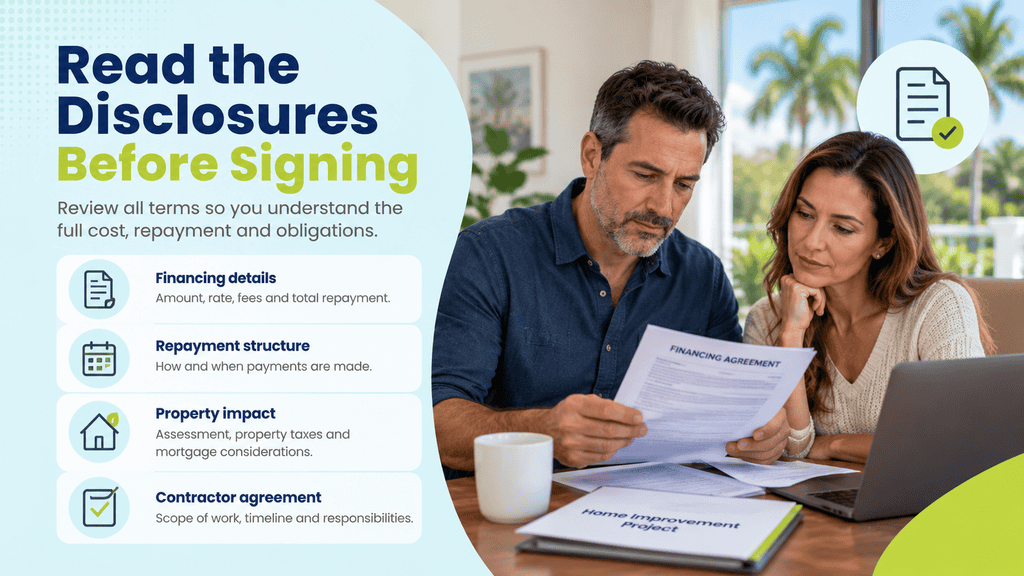
7. Read the disclosures before signing
Financial comparisons become less useful when homeowners compare marketing pages without comparing the final documents.
Florida’s residential PACE framework includes required disclosures and statutory protections. Ygrene also describes its financing agreement review and disclosure process on its consumer protection page.
For a HELOC, federal rules also require lenders to disclose important information about costs and account terms.
Review the financing agreement, contractor agreement, amount financed, interest rate, fees, repayment schedule, total repayment, property-tax implications, escrow implications and payoff provisions before committing.
A decision checklist for Florida homeowners
Before choosing between PACE financing and a HELOC, work through this sequence:
- Define the project precisely. Get a written contractor scope and complete price so you’re comparing financing for the same amount of work.
- Check PACE availability. Confirm that the property is in a participating jurisdiction and that residential PACE is available there.
- Confirm project eligibility. Match the actual scope of work to current eligible-improvement requirements rather than assuming a general remodeling project qualifies.
- Get written financing terms. Compare the PACE documents with an actual HELOC offer, not estimated rates from advertisements or comparison sites.
- Calculate the total obligation. Include interest, finance charges, program or lender fees and other required costs over the period you expect to keep the financing.
- Consider future property plans. Review what a sale, refinance or early payoff could require and how the financing may affect property-tax or mortgage-escrow payments.
- Get professional guidance where your situation requires it. A mortgage lender, financial adviser, attorney, tax professional or real estate professional can address issues specific to your finances and property.
Check the project before deciding how to finance it
PACE financing and a HELOC can both be options for funding substantial home improvements, but they serve different needs.
A HELOC gives an eligible borrower a revolving line of credit and may make sense when flexible access to funds is important. PACE financing is tied to eligible property improvements and uses a property-tax assessment structure rather than conventional HELOC repayment.
For Florida homeowners considering Ygrene, the practical next step is to confirm that both the property location and proposed repair are eligible. Then compare the complete PACE financing terms with any HELOC or home equity offer you qualify for, including total repayment, fees, payment structure and future sale or refinance considerations.
FAQs
Is PACE financing the same as a HELOC?
No. A HELOC is an open-end line of credit secured by your home. PACE financing is used for qualifying property improvements and is repaid through a property assessment associated with the property.
Does Ygrene PACE financing require a credit score?
Ygrene currently states that it doesn’t require a minimum credit score and uses a soft credit pull to verify certain underwriting criteria. Qualification still depends on applicable property, home equity, ability-to-repay and program requirements, so approval isn’t automatic.
Is a HELOC rate fixed?
HELOCs usually have variable interest rates, although some products allow borrowers to convert part or all of the balance to a fixed rate. Review the lender’s actual rate structure rather than assuming every HELOC works the same way.
Does PACE increase my property-tax obligation?
PACE financing is repaid through a property assessment collected with property taxes. If your taxes are paid through mortgage escrow, the assessment may affect the amount your servicer collects, so review the payment impact before signing.
Can I use PACE financing for any Florida home repair?
No. The property must be in an eligible participating jurisdiction and the improvement must qualify under the applicable PACE program. Eligible categories can include roofing, impact-resistant windows and doors, HVAC work, storm-resilience improvements and certain sewer or septic projects.
What happens to PACE or a HELOC if I sell my home?
An unpaid PACE assessment can affect the sale process and must be handled according to the financing agreement, applicable Florida requirements and the requirements of parties involved in the transaction. A HELOC is also secured by the property, so homeowners should obtain a payoff amount and discuss the sale with their lender and closing professional.
Is PACE or a HELOC cheaper for home repairs?
There isn’t a universal answer. Compare the actual interest rate, fees, repayment period, total repayment and property-related obligations in each written offer. The better fit depends on the project, the homeowner’s qualifications, expected ownership period and financial circumstances.