
The phrase “PACE financing in Broward” usually comes up when a homeowner needs a major repair but doesn’t want to cover the entire project cost upfront. In Broward County, Property Assessed Clean Energy (PACE) financing may be available for qualifying improvements such as roofing, impact windows, HVAC systems and storm-resistance work.
This guide explains what Broward homeowners can potentially finance, how the property assessment works and what to review before signing an agreement.
PACE financing Broward homeowners search for: what it actually means
PACE is a financing structure for certain improvements that are permanently connected to a property. It’s different from taking out a conventional personal loan or opening a credit card.
For residential properties in Florida, state law allows an authorized program administrator to finance qualifying improvements in participating counties or municipalities. Repayment is collected as a non-ad valorem assessment associated with the property. A first-priority lien for the total amount financed will be placed on the property as collateral. PACE is not a governmental program. Florida’s requirements for residential PACE financing are set out in Section 163.081 of the Florida Statutes, as applicable. Availability depends on local authorization, program participation, the property, the proposed improvement, and satisfaction of current eligibility requirements.
That local authorization matters. Florida law doesn’t make residential PACE automatically available to every property in the state. A county or municipality must authorize a program administrator before residential financing can be offered within that jurisdiction.
Broward County currently identifies PACE as a financing option offered by outside providers rather than a county rebate or grant. The county also notes that PACE financing results in a lien on the property. Homeowners can review the county’s current guidance through the Broward County Sustainability PACE information.
Ygrene currently lists Broward County among its Florida service areas, including communities such as Fort Lauderdale, Hollywood, Pompano Beach, Pembroke Pines and Weston. Because participation is jurisdiction-specific, homeowners should still check the individual property through Ygrene’s Florida PACE service-area information rather than assuming every Broward address qualifies.
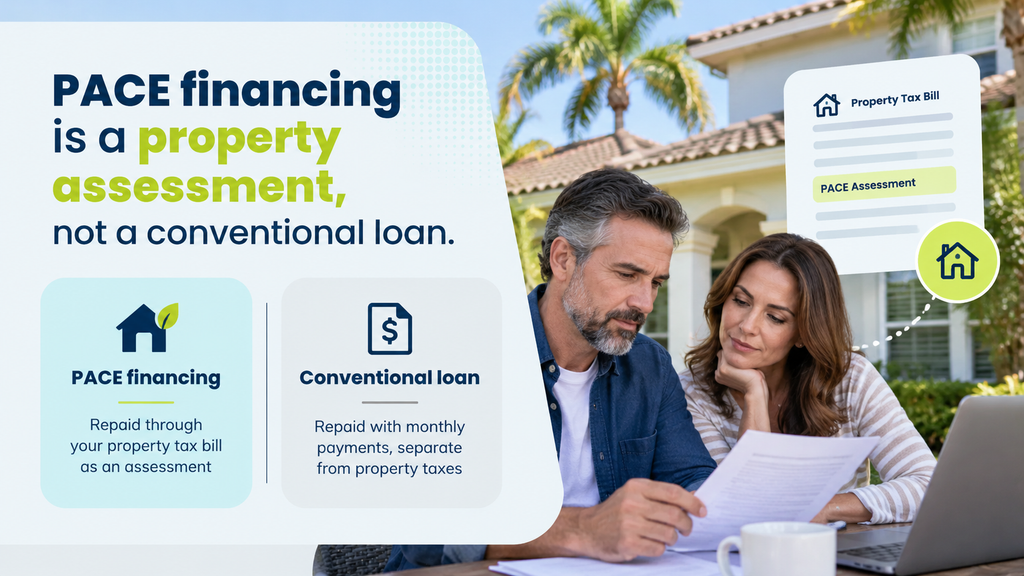
PACE financing is a property assessment, not a conventional loan
This distinction affects nearly every part of the decision.
Ygrene describes its PACE financing as a property assessment rather than a traditional consumer loan. The assessment is recorded against the improved property and repayment is made through the property-tax system according to the applicable collection schedule. A first-priority lien for the total amount financed will be placed on the property as collateral. PACE is not a governmental program.
Florida law provides for the residential PACE financing agreement or a memorandum of the agreement to be recorded in the county’s public records. The resulting non-ad valorem assessment becomes a property-related lien under Florida law.
That makes PACE materially different from unsecured financing.
It also means homeowners need to look beyond the cost of the improvement. The financing decision can affect property taxes, mortgage escrow, a future refinance and the process of selling the home.
What determines whether a property can qualify?
Residential PACE approval involves more than confirming that a project appears on an eligible-improvement list.
Florida law requires program administrators to review specified property and financial information before entering into a residential financing agreement. Ygrene also states that its qualification process considers home equity and ability to pay the assessment rather than relying on the applicant’s credit score alone.
Homeowners can review Ygrene’s current qualification criteria and application information in its PACE financing FAQ.
The requirements can include factors related to property-tax status, mortgage payments, property ownership, existing liens, equity and household income. Current statutory requirements should always be checked before relying on an older description of PACE eligibility.
A homeowner therefore shouldn’t interpret “PACE doesn’t rely on your credit score” as “there are no financial eligibility requirements.” Property-level and ability-to-repay criteria still apply.
What can PACE finance?
Broward homeowners often investigate PACE after receiving an estimate for a roof, windows or another significant property improvement. Whether a particular project qualifies depends on the improvement itself, current program requirements and the property.
Ygrene currently lists hundreds of Florida improvements across categories such as roofing, windows and doors, heating and cooling, sewerage, storm resistance and energy efficiency. Before signing a contractor agreement based on expected financing, compare the actual scope of work with Ygrene’s current list of PACE-eligible projects.
Roof installation and repair
Roofing is one of the common project categories listed for Ygrene PACE financing.
Ygrene’s current eligible-project information includes roof installation or repair under building-envelope improvements. It also identifies wind-resistant roofing, roof-deck attachment strengthening, secondary water barriers and roof-to-wall reinforcement among qualifying wind-resistance measures.
For a Broward homeowner, the practical question isn’t simply whether “roofs qualify.” The exact project scope matters.
For example, a contractor’s proposal may combine removal of existing materials, structural repairs, roof-deck work, underlayment, wind-resistance improvements, new roofing materials and related work.
Some parts may fit an eligible improvement category while others may have specific conditions. Ygrene currently states, for example, that gutters qualify when they accompany a roof replacement or water-collection system.
That is why homeowners should have the complete project scope checked rather than assuming every line item in a roofing estimate will qualify.
Impact windows, doors and storm protection
Impact-resistant openings are another relevant project category for Broward properties.
Ygrene currently includes high-impact windows, high-impact doors, storm shutters and other opening protections among eligible wind-resistant measures. Homeowners considering this type of work can also review Ygrene’s windows and doors financing information for current project details.
A homeowner replacing windows should still distinguish between two questions:
- Does the proposed product and installation qualify for PACE financing?
- Does the product satisfy the building, permitting, insurance or wind-mitigation requirements applicable to the property?
PACE eligibility doesn’t replace contractor licensing, permitting, product approval or building-code requirements. Those issues belong in the project-planning process and should be confirmed separately.
HVAC systems
Ygrene’s current eligibility information includes several heating, ventilation and air conditioning projects, such as central HVAC systems, mini-splits, certain heat pumps, duct replacement and duct sealing.
This can be relevant when a homeowner is dealing with an aging or failed system rather than planning an optional upgrade.
Still, “HVAC” covers many types of equipment and related work. The system configuration and project scope need to fit the current eligibility requirements. Homeowners should confirm that before treating a contractor quote as a financeable PACE project.
Septic, sewer and plumbing improvements
Ygrene also currently lists several sewerage projects, including plumbing repair, sewer lateral repair or replacement, sewer repiping, septic tank replacement, septic-to-sewer conversion and trenchless sewer-line work.
Florida law imposes additional requirements on certain septic-to-sewer conversions financed through residential PACE. For that reason, homeowners considering this type of work should investigate available local-government assistance or financing before assuming PACE will be the appropriate funding route.
Other improvements
Current eligible categories also include certain solar systems, water heating, insulation, electrical improvements, attached standby generators, pool equipment and other property improvements.
The project list is detailed enough that homeowners should confirm the exact improvement rather than relying on a broad category.
A project can sound energy-efficient or storm-related without necessarily satisfying the current requirements.
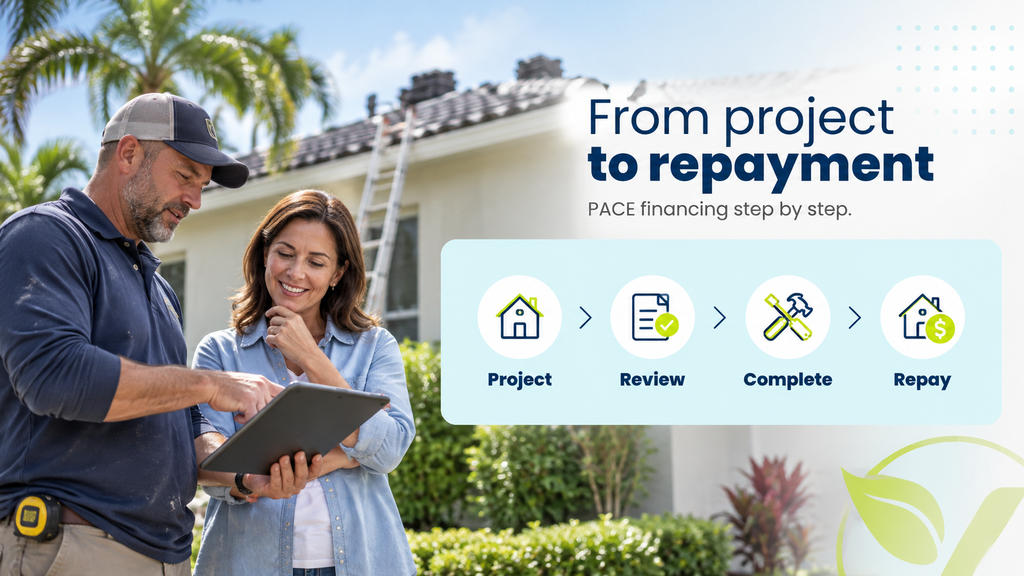
How Ygrene PACE financing works from project to repayment in Broward County
A useful way to evaluate PACE is to follow the project from the first contractor estimate through repayment.
Ygrene’s current process begins with confirming eligibility, choosing the project and contractor and reviewing the financing terms. The contractor performs the construction work while Ygrene provides the PACE financing. Homeowners can review the current process on Ygrene’s how PACE financing works page.
1. Confirm the property is in a participating area
Broward County has participating PACE jurisdictions but homeowners should verify their specific property.
This matters because Florida law allows counties and municipalities to authorize or deauthorize program administrators. A Broward County mailing address alone doesn’t establish eligibility.
2. Confirm the improvement qualifies
Match the contractor’s proposed scope to the current eligible-project requirements.
Don’t rely solely on a contractor saying that “PACE should cover it.” The program administrator should confirm eligibility before the homeowner proceeds on that assumption.
3. Review the complete contractor proposal
The contractor establishes the project price and performs the work.
Review the proposal for labor, materials, permits, equipment, warranties and change-order terms. If the estimate contains work outside the qualifying improvement, ask how those costs will be handled.
Florida’s residential PACE law also contains contractor-estimate disclosure requirements for qualifying improvements at specified project values. Review the current statutory wording before relying on a contractor’s financing presentation alone.
4. Review the financing estimate and disclosures
Florida law requires specific written financing information before a residential PACE agreement is executed.
Depending on the transaction, the disclosure addresses items such as the amount financed, project cost, applicable fees, interest, estimated annual assessment, financing term and expected repayment information.
Those figures provide a better basis for comparison than asking whether an annual or monthly equivalent payment simply “fits the budget.”
5. Complete the required review
Florida law includes a recorded telephone confirmation process before approval of a residential PACE financing agreement as well as a statutory cancellation period after signing.
Ygrene also provides information about disclosures, customer support and the responsibilities of the property owner through its consumer protection resources.
Use the review period to ask specific questions about anything that isn’t clear. The disclosures deserve the same attention as the contractor agreement.
6. The contractor completes the work
The contractor, rather than Ygrene or Broward County, performs the installation or repair.
Florida law places requirements around completion before final contractor funds are released. Depending on the project, permitting or other documentation may also be required.
Homeowners should still inspect the contractor agreement carefully because workmanship, construction quality and warranty responsibilities remain separate from the financing itself.
7. Repayment becomes part of the property-tax obligation
PACE repayment is collected as a non-ad valorem assessment associated with the property. A first-priority lien for the total amount financed will be placed on the property as collateral.
For a homeowner whose mortgage servicer handles property taxes through escrow, a new PACE assessment can also affect the amount that needs to be collected for property taxes.
This deserves careful budgeting. A homeowner accustomed to thinking about housing expenses monthly should calculate the monthly equivalent of the annual assessment even when the assessment itself follows the property-tax collection process.
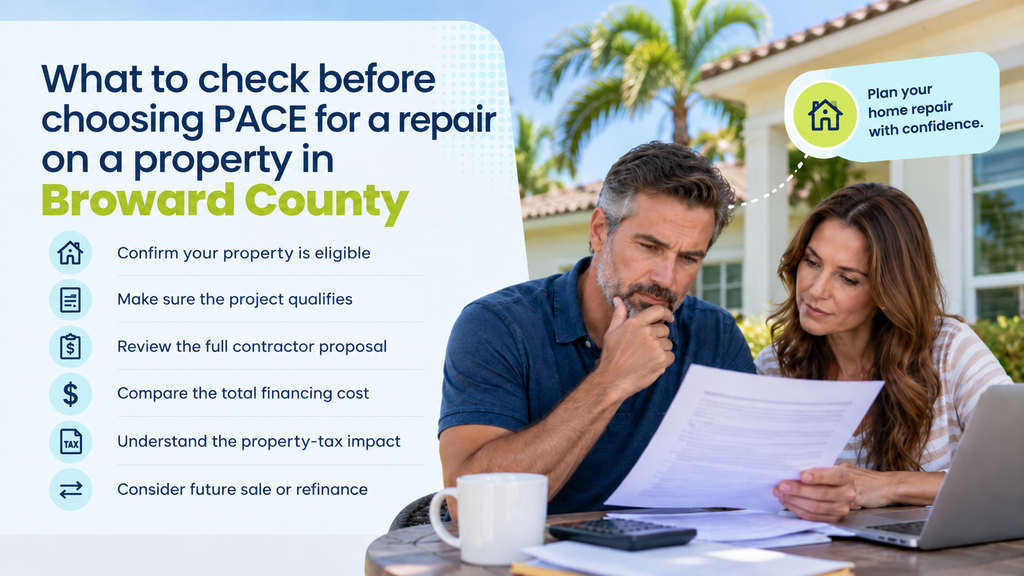
What to check before choosing PACE for a repair on a property in Broward County
The useful comparison isn’t simply, “Can I start the project?” It is, “What financial obligation am I accepting to complete it?”
Consider a hypothetical Broward homeowner who receives a roof replacement estimate after several repairs.
The homeowner might consider cash, a personal loan, home-equity financing or PACE if the property and roof qualify. PACE can address the project cost without requiring the entire amount upfront but it also creates a property assessment that needs to be considered alongside the mortgage, taxes and future plans.
| Option | How repayment generally works | Property connection | Project restrictions | Key question to ask |
| Cash | Paid from available funds | No financing assessment | No financing-provider restrictions | How much accessible savings will remain afterward? |
| Personal loan | Separate installment payment | Often unsecured, depending on the product | Usually not limited to PACE-eligible projects | What are the rate, fees, term and total repayment? |
| Home-equity financing | Separate payment under the financing agreement | Secured by home equity | Usually not limited to PACE project categories | How does the debt affect equity and future borrowing? |
| PACE financing | Repaid through a property assessment | Assessment is recorded against the property as a first-priority lien | Must involve qualifying improvements | What are the annual assessment, total repayment and sale or refinance implications? |
Terms vary across all these options. Compare actual written offers rather than general descriptions.
Review the total obligation
Don’t compare financing solely by the size or timing of one payment.
For PACE, review the contractor’s project price, total amount financed, applicable fees, interest rate, annual assessment, financing term, estimated total payments and effect on the property-tax or escrow obligation.
Florida’s required residential PACE disclosures are designed to provide important information about these costs before the homeowner signs.
Understand the property lien before signing
The recorded property obligation is a material feature of PACE.
Florida law establishes the treatment of the non-ad valorem assessment and its lien status. With PACE, a first-priority lien for the total amount financed will be placed on the property as collateral. Homeowners with a mortgage should understand that structure before agreeing to financing, especially when future refinancing or a property sale may be possible.
If the mortgage or escrow implications aren’t clear, discuss them with the mortgage servicer or an appropriate financial or legal professional before signing.
Think about selling or refinancing before choosing the term
A PACE assessment is tied to the property but that doesn’t guarantee that a future mortgage lender or buyer will accept the remaining obligation.
Current Ygrene information says PACE financing must be paid off in most cases when the property is sold and that PACE must be disclosed to potential buyers. Florida law also contains disclosure requirements for residential properties with an unpaid PACE assessment.
If you expect to move or refinance during the financing term, ask what payoff would involve before selecting that term.
Check early-payment provisions
Florida law addresses early repayment of residential PACE obligations and Ygrene currently states that customers can make qualifying partial or full early payments without a prepayment penalty.
Homeowners should still read the actual agreement for current processing rules and any applicable administrative requirements.
Early payoff can matter even when a sale or refinance isn’t currently planned. Understanding the procedure provides a more complete picture of the financing obligation.
A Broward homeowner’s checklist before signing
Use this process after receiving a project estimate but before committing to PACE financing.
- Verify your address. Confirm that Ygrene currently serves the jurisdiction where your property is located.
- Verify the exact project. Match the proposed work to the current eligible-improvement list rather than relying on a broad description such as “roof” or “windows.”
- Review the contractor quote. Identify labor, materials, permits, warranties and any work that may fall outside PACE eligibility.
- Compare contractor proposals when appropriate. Separate the contractor decision from the financing decision so you can evaluate both the project price and financing terms.
- Read the financing disclosure carefully. Check the amount financed, fees, rate, assessment, financing period, estimated repayment amounts and other required disclosures.
- Check your mortgage and escrow situation. Find out how the assessment may affect property-tax collections and what your lender may require if you later sell or refinance.
- Compare another realistic funding option. Obtain actual terms for any alternative you’re seriously considering instead of comparing PACE against assumptions.
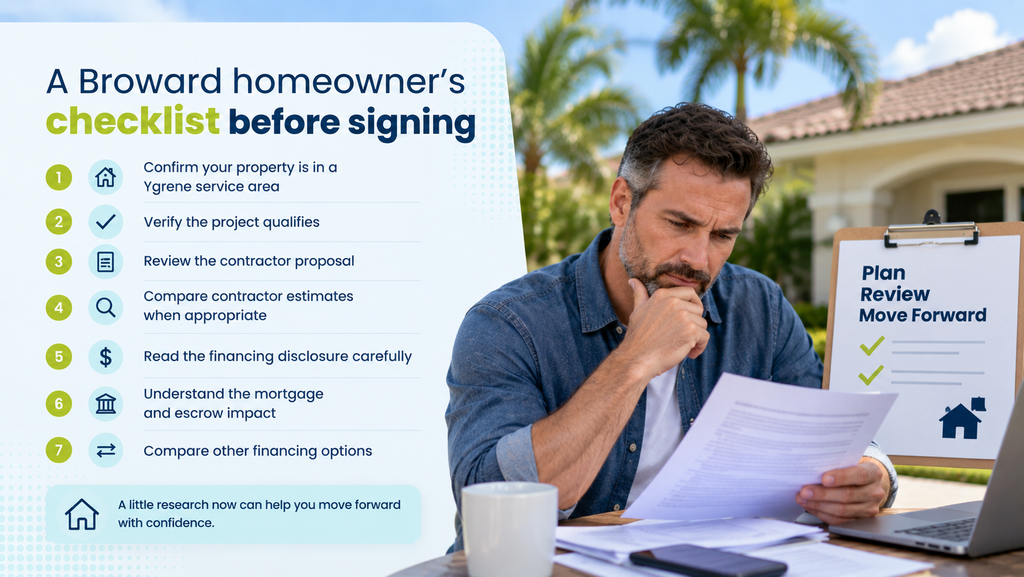
The purpose of this process is to understand how the project will be paid for and what that choice means for the property over time.
For questions that depend on your individual mortgage, taxes, finances or legal circumstances, consider speaking with the appropriate qualified professional before making a decision.
Check your Broward property and project before moving forward
If your Broward County home needs a roof, impact windows, HVAC work or another qualifying improvement, start by confirming that Ygrene currently serves your property’s jurisdiction and that the specific work is PACE eligible.
Then review the contractor price, financing disclosures, annual assessment, total repayment obligation and possible mortgage, sale or refinance implications before signing. Ygrene can determine whether the property and proposed project meet its current requirements, while the financing decision should come after you understand the full agreement.
FAQs
Is Ygrene PACE financing available in Broward County?
Ygrene currently lists Broward County among its Florida service areas and identifies multiple participating communities. Availability still needs to be confirmed for the individual property because PACE depends on local authorization and program requirements.
Can I use PACE financing for a roof in Broward County?
Roof installation and repair currently appear among Ygrene’s eligible Florida project categories. Wind-resistant roofing and several related roof-strengthening improvements are also listed, but the property and exact project scope still need to qualify.
Can PACE be used to finance impact windows in Broward County?
High-impact windows, high-impact doors and other opening protections currently appear among Ygrene’s eligible wind-resistant improvements. Financing eligibility doesn’t replace permitting, building-code compliance or the need to review the contractor agreement.
Does Ygrene check my credit?
Ygrene says approval is based on factors such as home equity and ability to pay rather than the applicant’s credit score. Its current disclosures also state that it performs a soft credit pull to verify certain underwriting criteria and that the soft pull doesn’t affect the credit score.
Does PACE get added to my property taxes?
PACE repayment is handled as a non-ad valorem property assessment. Homeowners should review how the assessment will appear within their property-tax obligations and whether a mortgage escrow account will need to collect additional funds.
What happens to PACE financing if I sell my Broward home?
Ygrene currently states that PACE financing must be paid off in most cases when a property is sold and that the assessment must be disclosed to potential buyers. Florida law also establishes disclosure requirements for properties with an unpaid residential PACE assessment, so homeowners planning a sale should discuss payoff requirements with the relevant lender and professionals.
Is the PACE financing program available in Broward County a government grant?
No. Broward County describes PACE as financing offered by outside providers rather than a rebate or grant. Ygrene likewise states that its PACE program isn’t government sponsored and that government assistance isn’t provided to repay the assessment.