
For homeowners researching PACE financing in Palm Beach County, the first questions are usually practical: Is PACE available at my address? What repairs can it finance? How does repayment affect my property taxes?
Palm Beach County supports PACE financing in participating jurisdictions and Ygrene lists Palm Beach County among its Florida service areas. This guide explains how the program works, which home improvements may qualify and what homeowners should review before agreeing to a property assessment.
How PACE financing in Palm Beach County works
Property Assessed Clean Energy, or PACE, is a way to finance qualifying improvements to real property. It differs from a conventional personal loan because the financing creates an assessment on the property and repayment is collected through the property-tax system. A first-priority lien for the total amount financed will be placed on the property as collateral.
The Palm Beach County PACE program describes PACE as a voluntary non-ad valorem assessment on the annual property tax bill. The county also makes an important distinction: PACE is an assessment on the property, not a governmental program, grant or a Palm Beach County Board of County Commissioners financing program.
That distinction matters when homeowners compare financing options.
With Ygrene PACE financing, the improved property serves as collateral and the financing is secured through a first-priority recorded lien. Repayment is made through the property-tax system and available terms vary depending on the service area and type of improvement.
The Consumer Financial Protection Bureau similarly defines residential PACE financing as financing for home improvements that results in a tax assessment on the consumer’s real property. Its residential PACE financing rule addresses federal ability-to-repay and consumer disclosure requirements.
For a Palm Beach County homeowner, the basic structure looks like this:
- Confirm that the property is within an eligible PACE jurisdiction.
- Identify a proposed improvement that qualifies.
- Apply with an authorized PACE financing provider.
- Review the proposed assessment and all financing disclosures.
- Select and contract with the appropriate contractor.
- Complete and verify the qualifying work.
- Repay the assessment through the property-tax system according to the financing agreement.
The details matter at each step. A homeowner shouldn’t assume that being located somewhere in Palm Beach County automatically means every property, project or applicant will qualify.
Is PACE available throughout Palm Beach County?
Ygrene lists Palm Beach County among the Florida counties where it offers PACE financing in approved jurisdictions. Its service-area directory includes locations such as Boca Raton, Boynton Beach, Delray Beach, Jupiter, Lake Worth Beach, Palm Beach, Palm Beach Gardens, Royal Palm Beach, Wellington, West Palm Beach and various unincorporated communities.
Palm Beach County’s own PACE information also confirms that PACE financing is available in the county through independently administered providers.
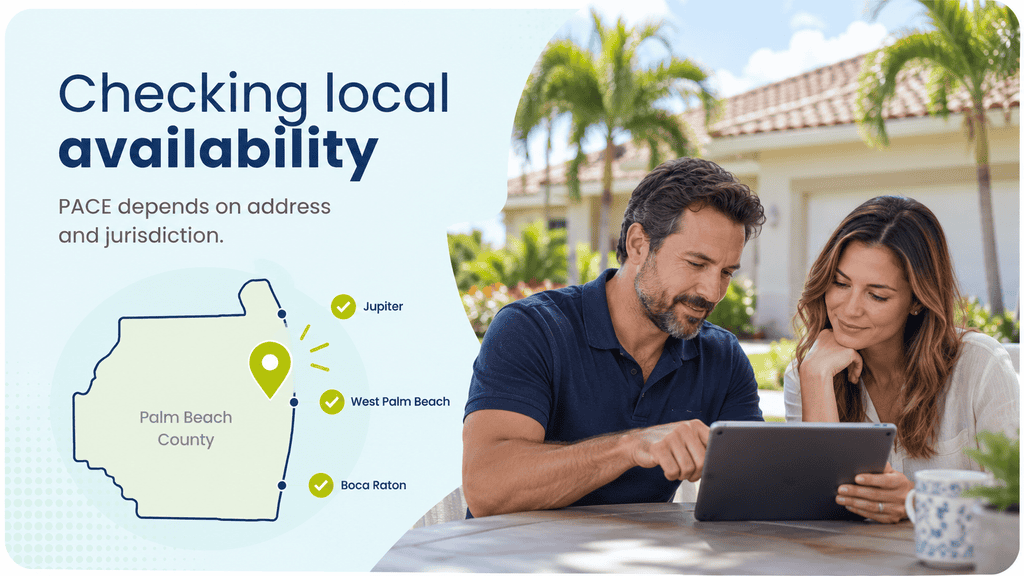
Local authorization is significant because Florida law requires a residential PACE program administrator to be authorized by the relevant county or municipality before offering financing within that jurisdiction.
So before planning around PACE, verify your specific address rather than relying only on the county name. Ygrene maintains a directory of Florida PACE financing service areas where property owners can review participating locations.
What can the PACE program finance in Palm Beach County?
PACE isn’t general-purpose financing that can be used for any remodeling project. The proposed improvement must fall within qualifying categories and satisfy applicable program requirements.
Ygrene’s Florida eligibility information includes potential improvements across categories such as roofing, wind resistance, windows and doors, HVAC, sewer and septic systems, energy efficiency, water heating and renewable energy.
For Palm Beach County homeowners, common examples may include:
- Roof installation or repair
- Wind-resistant roofing
- High-impact windows and doors
- Storm shutters and other opening protections
- Roof deck attachment strengthening
- Roof-to-wall reinforcement
- Central HVAC replacement
- Heat pumps and qualifying ventilation improvements
- Septic tank replacement
- Septic-to-sewer conversion
- Sewer lateral repair or replacement
- Plumbing repairs
- Insulation and certain building-envelope improvements
- Solar photovoltaic systems that meet applicable requirements
- Certain water-heating and energy-efficiency projects
Some improvement categories have additional conditions. For example, certain items qualify only when paired with another eligible project. Homeowners should therefore verify the exact proposed scope rather than assuming that an entire project qualifies because one component appears on a general list.
Before discussing financing with a contractor, review Ygrene’s eligible PACE home improvement projects to understand which improvements may qualify and whether additional requirements apply.
A hypothetical Palm Beach County roofing example
Consider a homeowner in West Palm Beach whose roof has reached the point where replacement is being planned.
The homeowner receives a contractor estimate and learns that the proposed roof replacement may be PACE eligible. Instead of immediately signing the contractor agreement or financing documents, the homeowner could first confirm that the property address is eligible and that the proposed roofing work meets current program requirements.
If PACE remains an option, the homeowner could then review:
- The complete contractor price
- The amount being financed
- The applicable interest rate
- Finance charges and fees
- The length of the financing term
- The resulting PACE assessment
- The total amount expected to be repaid
- How the assessment will affect property-tax payments
- Early-payoff provisions
- Potential sale or refinance implications
The homeowner could then compare the PACE proposal with other realistic funding options before deciding.
That comparison is more useful than focusing only on whether the roof itself qualifies.
What homeowners should understand before choosing Ygrene in Palm Beach County
PACE can help spread the expense of a qualifying property improvement over time, but the financing creates a meaningful obligation tied to the property. A first-priority lien for the total amount financed will be placed on the property as collateral.
Anyone evaluating Ygrene in Palm Beach County should understand the assessment structure before signing.
Repayment is connected to property taxes
A special assessment is added to the property-tax bill as a separate line item and follows the same payment schedule as the property taxes.
If the homeowner’s mortgage servicer handles taxes through an escrow account, the assessment can affect the amount collected for property taxes.
That means homeowners should budget based on the complete property-tax impact rather than comparing only a PACE payment figure with the monthly payment on another financing product.
For example, a homeowner with a mortgage escrow account may experience an adjustment to the amount the mortgage servicer collects for taxes. Someone who pays property taxes directly should instead plan for the increased tax obligation when it becomes due.
The financing is secured by the property
PACE financing creates a property-related obligation. Florida law provides for a non-ad valorem assessment and allows a notice of first priority lien for the financed amount to be recorded in the county’s public records.
The assessment lien has equal dignity with county taxes and assessments from the date of recordation.
These provisions are addressed in Section 163.081 of the Florida Statutes, which establishes requirements for financing qualifying improvements to residential property.
This makes affordability especially important. Palm Beach County warns property owners that failure to pay the PACE assessment can have serious consequences because the assessment is collected through the property-tax system.
Property owners should therefore evaluate the assessment alongside their existing mortgage obligations, insurance premiums, property taxes and other recurring housing expenses.
Sale and refinancing plans matter
A common misconception is that homeowners don’t need to think about a PACE assessment until the end of its scheduled term.
A sale or refinance can change that.
Although an assessment is associated with the property, the seller’s or buyer’s mortgage lender will most likely require the remaining assessment balance to be paid before a sale or refinancing can proceed.
Florida law also requires disclosure to a prospective purchaser when residential property has an outstanding PACE assessment.
If you expect to move, refinance your mortgage or access home equity during the financing period, ask specifically how your proposed assessment would be handled.
For example, a homeowner planning to refinance in a few years should contact the mortgage lender before signing the PACE agreement. The lender may have requirements that affect the homeowner’s financing plans.
Knowing those requirements ahead of time can help homeowners compare the full cost and flexibility of PACE against other funding options.
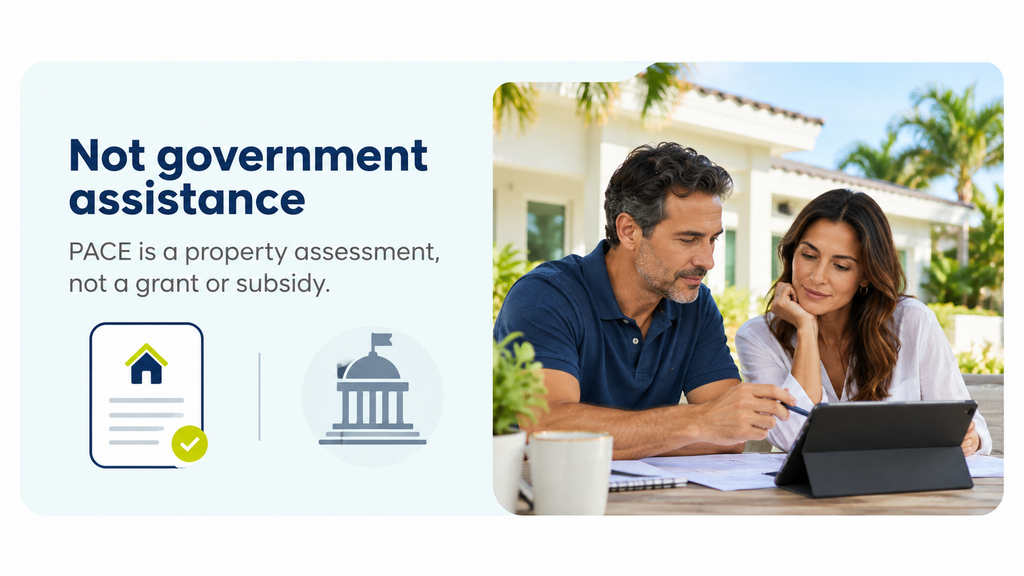
PACE isn’t government assistance
Palm Beach County authorizes PACE activity, but that doesn’t make the financing a government program, grant, or subsidy.
The county describes PACE as a voluntary property assessment and explains that it isn’t a Palm Beach County Board of County Commissioners financing program.
Ygrene likewise states that its PACE program isn’t government sponsored and that government assistance isn’t available to pay the assessment.
Construction work is also performed by the homeowner’s contractor, not by Ygrene or the government.
Homeowners remain responsible for reviewing the contractor agreement, understanding the scope of work and meeting the obligations described in their financing documents.
How to evaluate PACE financing for Palm Beach County homeowners before signing
The best way to compare a PACE proposal is to examine the entire obligation alongside realistic alternatives.
PACE may solve an important practical problem when a qualifying repair is needed and paying the whole project cost upfront isn’t desirable. That doesn’t mean it will be the right financing structure for every homeowner.
Palm Beach County advises property owners to consider other available financing choices and determine which is appropriate for their financial circumstances.
The goal is to compare the same factors across each option instead of judging financing by one headline feature.
| Financing option | What homeowners should examine |
| PACE financing | Assessment amount, interest rate, fees, repayment term, total repayment, property-tax impact, lien and sale or refinance considerations |
| Cash | Amount of savings used and whether enough reserves remain for other expenses |
| Personal loan | Interest rate, fees, monthly payment, repayment term, total cost and qualification requirements |
| Home-equity financing | Interest rate, closing costs, repayment structure, equity requirements and property-related obligations |
| Contractor financing | Financing provider, interest rate, fees, promotional terms, repayment schedule and total financing cost |
There isn’t one answer that works for every Palm Beach County homeowner.
Someone planning to remain in the same home for many years may evaluate a PACE assessment differently from someone expecting to sell soon.
Similarly, a homeowner with sufficient cash reserves might prefer avoiding financing charges, while another property owner may prioritize preserving cash for other necessary expenses.
The decision should reflect the complete financial picture.
A practical review checklist
Before agreeing to a PACE assessment, work through these questions:
1. Is the exact property address eligible? Confirm current jurisdictional availability.
2. Does the exact project qualify? Check the planned improvement and any conditions attached to eligibility.
3. What is the contractor’s full project price? Understand labor, materials, permits and other project charges before adding financing costs.
4. How much will actually be financed? Confirm the assessment amount rather than relying only on the contractor estimate.
5. What rate and finance charges apply? Review the written financing disclosures.
6. What is the total repayment amount? A longer repayment period may reduce the amount due during each payment period while increasing total interest paid.
7. How will the assessment affect your property taxes? Consider both direct tax payments and mortgage escrow arrangements.
8. What happens if you pay the assessment off early? Review the financing agreement for payoff procedures and any applicable charges.
9. Could you sell or refinance during the term? Discuss potential requirements with your mortgage professional or lender before assuming the assessment can remain in place.
10. Have you compared at least one realistic alternative? Look at total cost, repayment structure, qualification requirements and property-related consequences.
Homeowners should also review all required disclosures rather than relying solely on a contractor’s explanation. Ygrene outlines its approach to PACE financing consumer protections, including information intended to help property owners understand financing obligations.
These disclosures don’t eliminate financial risk or replace independent professional advice when a homeowner’s circumstances require it.
What applying for Ygrene PACE financing involves
Ygrene’s application process begins with confirming that the property is located in an eligible service area and submitting an application.
Ygrene says approval considers factors including property equity and ability to repay. It also performs a soft credit pull to verify certain underwriting criteria, which the company states doesn’t affect the applicant’s credit score.
This shouldn’t be interpreted as guaranteed eligibility. Florida law requires program administrators to make specified findings before entering into a residential PACE financing agreement and current Ygrene requirements must also be satisfied.
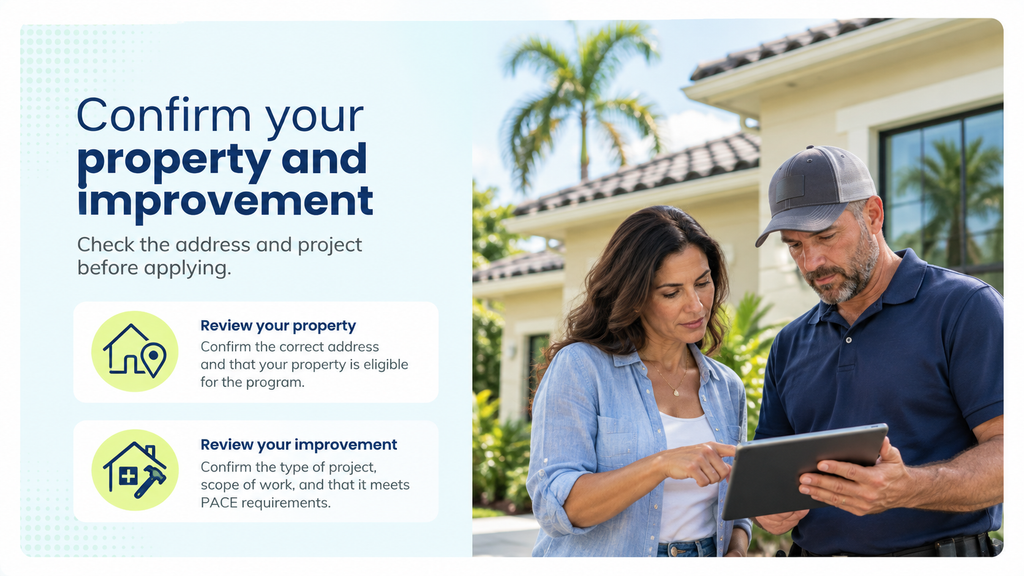
Confirm your property and improvement
Before applying, homeowners should determine whether their property is located in an eligible jurisdiction.
The proposed improvement must also meet the financing provider’s project requirements.
For instance, a Palm Beach County homeowner considering impact-resistant windows should confirm that the specific windows, installation scope and project documentation meet current PACE eligibility requirements.
A contractor’s general statement that a project qualifies shouldn’t replace that verification.
Review the financing proposal
If the property and project pass the initial review, the homeowner should examine the complete financing proposal.
Important details include the assessment amount, interest rate, repayment period, finance charges and total repayment obligation.
Homeowners should understand whether the assessment will change their mortgage escrow collection and how the financing might affect future property transactions.
They should also review any required consumer disclosures and ask questions about terms they don’t understand.
Coordinate with the contractor
The financing provider and contractor have separate roles.
The contractor is responsible for performing the home improvement. Ygrene provides the PACE financing and verifies applicable project requirements.
Florida’s residential PACE framework also includes requirements concerning qualifying improvements, contractor participation and confirmation of project completion before final disbursement.
Homeowners should independently review the contractor agreement, project scope, permits, warranties and pricing.
Ygrene explains the application, project completion and repayment stages in its overview of how PACE financing works, which homeowners can use to understand the general process before submitting an application.
Understand what happens after completion
Once the qualifying work has been completed and the financing requirements have been satisfied, repayment follows the schedule established in the financing agreement.
The PACE assessment becomes part of the property’s tax-related obligations.
Homeowners should retain copies of their financing documents, contractor agreement, project completion records and relevant disclosures.
Keeping these records organized can be helpful if questions arise about payments, an early payoff, refinancing or a future property sale.
Check your Palm Beach County property before making a financing decision
For a Palm Beach County homeowner dealing with a roof replacement, impact-window installation, HVAC replacement, septic project or another qualifying improvement, PACE can be one financing path to consider.
Start with the property rather than the financing pitch.
Confirm that your Palm Beach County address is within a current Ygrene service area. Then verify that the proposed improvement is eligible and obtain a complete contractor price.
Only after those points are clear should you compare the financing amount, rate, charges, assessment, total repayment and property-tax effect with other available ways to fund the work.
If Ygrene PACE financing remains a good fit after that review, the next step is to check your property’s eligibility for Ygrene PACE financing and examine the specific financing disclosures before committing to the project.
FAQs
Is PACE financing available in Palm Beach County?
Yes. Palm Beach County states that PACE financing is available within participating areas and Ygrene lists Palm Beach County among its Florida service areas. Availability still needs to be confirmed for the specific property and jurisdiction.
Is the Palm Beach PACE program a government loan?
No. Palm Beach County describes PACE as a voluntary property assessment and states that it isn’t a county loan or grant program. Ygrene also states that its PACE financing isn’t government sponsored and no government assistance is provided to pay the assessment.
What improvements can Ygrene finance in Palm Beach County?
Ygrene’s eligibility categories include roofing, impact windows and doors, HVAC, storm-resistance measures, sewer and septic projects, certain plumbing work, energy-efficiency improvements and other qualifying projects. Eligibility depends on the exact improvement, property and applicable program requirements.
Does Ygrene check my credit score?
Ygrene states that it doesn’t use a minimum credit score as the basis for approval but does conduct a soft credit pull to verify certain underwriting criteria. The company states that this soft inquiry doesn’t affect the applicant’s credit score. Property equity, ability to repay and other applicable requirements are also considered.
How do I repay PACE financing in Palm Beach County?
PACE repayment is collected through the property-tax system as a non-ad valorem assessment. Ygrene states that its assessment appears as a line item on the property-tax bill and follows the property’s tax-payment schedule. Homeowners who pay taxes through mortgage escrow should understand how the assessment may affect their escrow payments.
What happens to PACE financing if I sell my home?
Florida law requires disclosure of an outstanding residential PACE assessment to a prospective purchaser. Although the assessment is tied to the property, a mortgage lender involved in a sale will most likely require the remaining balance to be paid. Homeowners planning a sale should investigate lender requirements in advance.
Can PACE financing affect a mortgage refinance?
It can. Palm Beach County advises that a mortgage lender may require the remaining PACE assessment to be paid before refinancing. Homeowners expecting to refinance should discuss the proposed assessment with their mortgage lender and review the financing agreement before proceeding.