
If you’re trying to finance roof replacement Florida costs without paying the full contractor bill upfront, you have several possible funding paths. They include PACE financing, home-equity products, personal loans and contractor financing.
For Florida homeowners, the important question isn’t simply whether you can start a roof with no money down. You also need to compare qualification requirements, total financing costs, repayment terms and what happens if you sell or refinance your home.
How to pay for a new roof when you don’t have cash upfront
A full roof replacement can become necessary before you’ve saved enough to pay the contractor in cash. That leaves two separate decisions: which roof work your home needs and how you will pay for it.
Before financing anything, get a written contractor proposal that identifies the scope of work and total project price. Review whether permitting, tear-off, disposal, decking repairs, underlayment and other necessary work are included. A low initial quote can become much more expensive when important items are added later.
Once you know the actual project cost, you can compare funding options on the same basis.
Common ways to pay for a new roof include:
- Cash or savings. You avoid financing charges but must provide the project cost yourself.
- Home-equity financing. A home equity loan or home equity line of credit (HELOC) lets eligible homeowners borrow against their home’s equity. The Consumer Financial Protection Bureau notes that these products use the home as collateral. Learn how home-equity financing works.
- Personal loans. These generally provide borrowed funds that are repaid separately from your mortgage and property taxes. Qualification, rates and terms depend on the lender and borrower.
- Contractor financing. Some roofing companies offer financing through third-party providers. Terms can vary considerably, so review the underlying financing agreement rather than relying only on the advertised payment.
- PACE financing. Property Assessed Clean Energy financing can finance qualifying property improvements through a voluntary assessment secured by the improved property. For eligible Florida residential properties, state law specifically includes repairing, replacing or improving a roof among qualifying improvements. Florida Statutes section 163.08 describes qualifying residential improvements.
No money down doesn’t mean no cost. It means the financing structure may allow the project to begin without you paying the entire financed project cost in cash at the start. You remain responsible for repayment under the applicable agreement.
A hypothetical Florida roofing scenario
Suppose a homeowner receives a contractor estimate for a roof that needs full replacement. The homeowner has enough emergency savings for routine expenses but doesn’t want to spend most of those reserves on the roof.
They could compare a HELOC, personal loan, contractor financing and PACE financing. Instead of comparing only the initial payment, they would review the interest rate, financing charges, repayment period, estimated total repayment and any property-related consequences.
If the homeowner expects to refinance or sell within a few years, that should also be part of the decision. A financing structure that works well for someone staying in the home long term may be less suitable for someone expecting a near-term real-estate transaction.
How roof financing with no money down at closing through PACE works
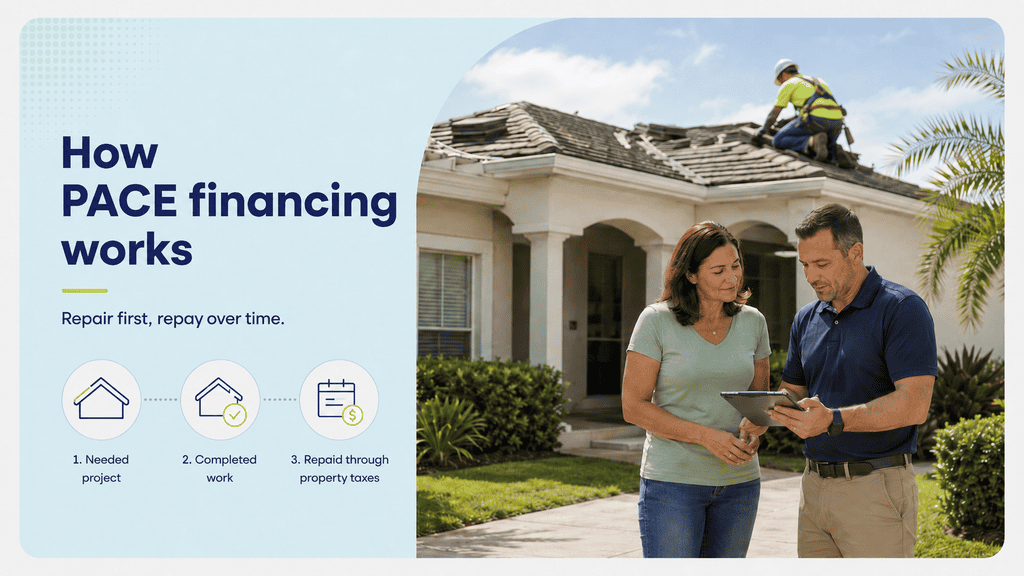
For qualifying Florida properties, Ygrene offers Property Assessed Clean Energy (PACE) financing for eligible improvements including roof installation and repair. Ygrene describes PACE as a property assessment rather than a conventional personal loan.
That distinction matters.
With conventional consumer lending, you generally borrow money under a loan or revolving credit agreement and make payments according to that agreement. With PACE financing, the obligation is connected to the improved property through an assessment;. a first priority lien for the total amount financed will be placed on your home as collateral. PACE is not a government sponsored program and there is no government assistance available to pay the assessment
Ygrene’s current materials state that residential PACE financing can offer fixed rates with repayment terms of up to 20 years, though available terms depend on the service area and improvement. The company also states that it uses a soft credit pull for specified underwriting criteria and that the soft inquiry doesn’t affect the applicant’s credit score.
Homeowners interested in this structure can review how Ygrene PACE financing works before deciding whether to apply.
Where the “no money down” part comes in
Ygrene currently states that eligible homeowners can finance qualifying work without bringing money to closing and that repayment begins after the financed repairs are installed. The contractor completes the work and Ygrene pays the contractor after the applicable completion verification.
That may help someone who needs a roof but doesn’t have enough liquid cash to cover the contractor’s full price upfront.
Interest still accrues according to the financing terms. Ygrene’s disclosures also state that the timing of the first payment depends on the date the project is funded.
How repayment differs from a monthly roof loan
PACE financing is repaid through a property assessment collected with property taxes. According to Ygrene, homeowners who pay property taxes directly pay the PACE assessment according to their county’s tax schedule. When taxes are handled through mortgage escrow, the mortgage servicer may collect the amount as part of the funds used to pay the property-tax bill.
That can change a homeowner’s housing-related cash flow even though there isn’t a separate monthly PACE loan bill.
Before signing, homeowners with escrow accounts should ask their mortgage servicer how an additional property-tax assessment could affect the amount collected through escrow.
PACE creates a property-related lien
Ygrene’s current disclosures state that the improved property serves as collateral and that the financed amount is secured through a recorded first-priority lien. Its FAQ also explains that the assessment has priority over existing liens including mortgages.
This is a material difference from unsecured financing.
Florida law also requires residential PACE disclosures covering the financing amount, annual non-ad valorem assessment, financing term, interest, estimated annual percentage rate, first payment date and other material obligations. The statutory disclosures must address the possibility that a mortgage lender could require payoff during a sale or refinance.
PACE shouldn’t be evaluated solely on whether you can start the roof without making a down payment.
How to finance roof replacement in Florida step by step
If you’re researching how to pay for a new roof, separating the roofing decision from the financing decision can prevent important details from getting lost.
1. Confirm that replacement is actually the recommended scope
Have an appropriately licensed roofing professional inspect the roof and provide a written scope.
Ask what needs replacement now, what damage has been found and whether additional work could become necessary once the existing roofing materials are removed. The financing amount should be based on a reasonably complete project proposal rather than a rough headline price.
2. Check whether your property and project are eligible
PACE availability isn’t universal throughout Florida. Ygrene states that its PACE financing is available in Florida jurisdictions where the necessary local authorization is in place.
Check Ygrene’s current Florida PACE service areas for your property’s location instead of assuming your county or municipality participates.
Then confirm the project itself. Ygrene’s current eligible Florida projects include roof installation and repair among residential building-envelope improvements. Florida law also expressly includes roof repair, replacement and qualifying roof-strengthening work within residential PACE improvements.
3. Get the complete project cost
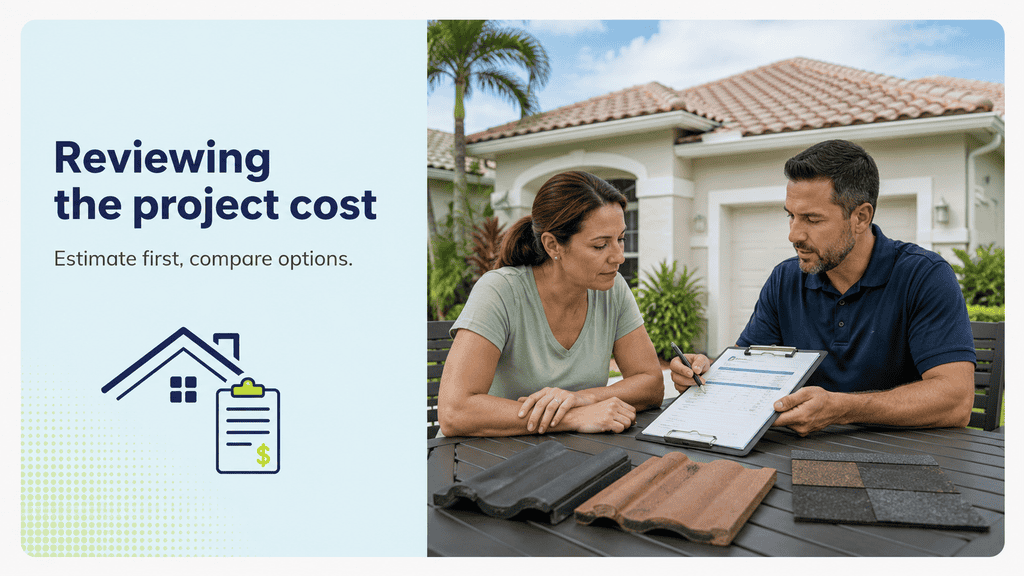
Don’t finance based solely on an advertised roofing price.
Ask the contractor to identify what the proposal includes. Depending on the project, that may involve removal of the old roofing material, disposal, underlayment, roof deck work, flashing, ventilation, permits and other items required to complete the job.
Also find out how change orders will be handled.
Florida’s residential PACE rules include additional protections for significant change orders. A qualifying change that increases the original improvement cost or expands the scope by at least the statutory threshold requires updated disclosures and written approval before increasing the financed amount.
4. Compare at least two realistic ways to finance the roof
The right comparison depends on what you can actually qualify for.
A homeowner with substantial savings may compare cash against financing. Someone with sufficient home equity and qualifying credit may add a HELOC or home equity loan. Another homeowner may compare PACE against a personal loan or contractor financing.
Use the same project price for every comparison.
| Financing option | Upfront cash | Repayment | What to examine closely |
| Cash | Full project amount | None after payment | Effect on emergency reserves and other planned expenses |
| Home equity loan | Varies | Regular loan payments | Rate, closing costs, term, total cost and home used as collateral |
| HELOC | Varies | Revolving credit payments | Variable-rate risk where applicable, fees, draw period and home used as collateral |
| Personal loan | Varies | Separate loan payments | Credit requirements, APR, fees, term and total repayment |
| Contractor financing | Varies by provider | Financing-provider schedule | Promotional terms, deferred-interest provisions where applicable, APR and fees |
| Ygrene PACE financing | Ygrene currently offers qualifying projects with no money down at close | Assessment paid with property taxes | Assessment amount, fixed rate, financing charges, term, lien and sale or refinance implications |
The CFPB recommends comparing other available sources of funds before deciding on a HELOC because different products carry different costs and risks. The same principle is useful when evaluating roof financing generally.
5. Read the PACE disclosures as carefully as the roofing contract
The contractor agreement tells you what work is being purchased. The PACE financing agreement tells you what you’re agreeing to pay.
Florida’s current residential PACE requirements call for disclosures that include the estimated amount financed, itemized improvement cost, program fees, capitalized interest, estimated annual assessment, term, interest charged and estimated APR. The disclosure also addresses the total estimated annual cost and the estimated first payment date.
Ygrene also maintains a consumer protection resource describing its financing disclosures, agreement review process and customer support.
Don’t sign until the amounts in the financing paperwork match your understanding of the contractor proposal and project scope.
6. Ask what happens if you sell, refinance or pay early
This deserves attention even if you aren’t planning to move immediately.
Ygrene states that homeowners are likely going to need to pay off the remaining PACE financing when selling or refinancing because many mortgage lenders require the assessment to be satisfied as a condition of the transaction. Ygrene recommends discussing that possibility with your lender.
For residential properties, Ygrene currently states that there is no prepayment penalty for paying the financing off early. Its current how-it-works page also discusses partial and full early payments.
Ask for the exact payoff process that applies to your agreement rather than assuming the assessment will automatically remain in place after a sale.
7. Check the numbers against your full household budget
A payment can look manageable in isolation while still putting pressure on your overall housing costs.
Review your mortgage payment, property taxes, homeowners insurance, existing debt, recurring household expenses and emergency savings. If your mortgage servicer manages taxes through escrow, ask how the new assessment may change the escrow amount.
For a major financing commitment secured by your property, consider discussing the terms with an appropriate financial, legal, mortgage, tax or real-estate professional if you’re unsure how the obligation could affect your individual situation.
What to review before choosing PACE for a Florida roof
Roof financing no money down Florida searches often focus on the immediate problem: “How can I get the roof started?”
A more useful question is: “What am I agreeing to after the roof is finished?”
Understand the qualification requirements
Ygrene says residential approval considers property equity and ability to repay rather than requiring a minimum credit score as the approval basis. A soft credit pull is still used to verify certain underwriting information.
Its current FAQ lists additional underwriting criteria including property-tax and mortgage-payment history, title ownership requirements, property equity and other property or financial conditions. Those criteria can change, so homeowners should confirm the current requirements during the application process rather than relying on an older article or prior applicant’s experience.
Approval should never be assumed simply because the roof itself is an eligible improvement.
Review the complete cost, not just the payment
A longer financing term can reduce the amount that must be budgeted at each payment interval but can also increase the length of time interest accrues.
Before signing, identify:
- The contractor’s total project price.
- The amount being financed.
- The interest rate and estimated APR.
- All financing or program fees included in the assessment.
- The repayment term and payment schedule.
- The estimated annual assessment and total repayment obligation.
- The estimated first payment date.
Florida’s residential PACE law requires many of these figures to appear in the financing estimate and disclosure.
Consider your mortgage before you sign
PACE’s lien position is one of the biggest differences between this form of financing and some alternatives.
Florida law requires notice to existing mortgage holders or servicers before a residential PACE financing agreement is entered into. Ygrene’s disclosures also explain that its assessment is secured by a first-priority property lien.
If you’re considering refinancing soon, speak with your mortgage lender first. Ask whether an outstanding PACE assessment would need to be paid before the lender completes the refinance.
Don’t treat PACE as a government grant
PACE programs exist because state and local governments authorize the assessment structure, but the financing itself isn’t free government assistance.
Ygrene explicitly states that its PACE program isn’t government sponsored and that no government assistance is provided to repay the assessment. The homeowner is responsible for repayment under the financing terms.
That distinction is important when comparing PACE with actual rebate, grant or incentive programs.
Keep the contractor decision separate from the financing decision
PACE financing pays for the qualifying project. The roofing company performs the roof work.
Ygrene’s disclosures state that improvements financed through its PACE assessment are installed by the homeowner’s contractor, not by Ygrene or a government entity.
Review the contractor’s license, scope, warranties, payment terms, permitting responsibilities and change-order process separately from the financing agreement.
When no-money-down roof financing may fit your situation
No single funding method is appropriate for every homeowner.
PACE may be worth comparing with other choices when a qualifying roof replacement needs to move forward, paying the full project cost upfront would put too much pressure on available cash and the property meets current program requirements.
It deserves closer scrutiny when you’re likely to sell or refinance soon, when the additional property assessment could strain your budget or when another financing product gives you a lower overall cost or structure that better matches your plans.
The decision process can be summarized this way:
- Get a written roof assessment and detailed contractor proposal.
- Confirm that your property is in a participating Ygrene service area.
- Confirm that the roof work qualifies under the current PACE program.
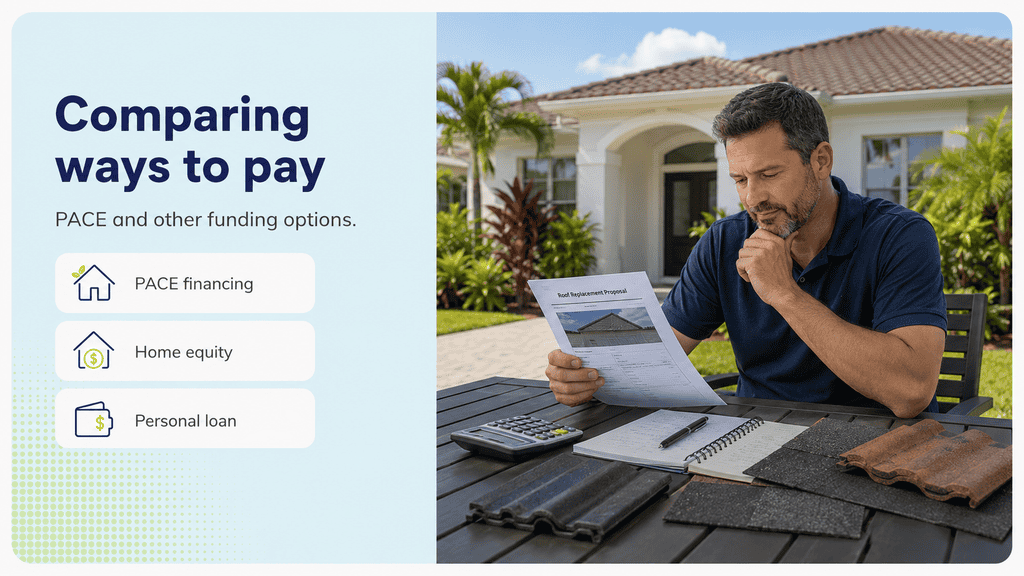
- Compare PACE with financing options you can realistically obtain.
- Compare total costs rather than only the first or lowest payment.
- Review the property-tax assessment and lien implications.
- Ask your mortgage lender about future refinance or sale requirements if either is reasonably likely.
- Read the financing disclosures and contractor documents before signing.
- Keep copies of your project, financing and completion records.
- Get professional guidance when your mortgage, tax, legal or financial circumstances make the decision more complicated.
That process takes more effort than simply choosing the first company advertising no money down, but it gives you a much clearer picture of what the roof will cost and how the obligation fits your property.
Check whether your Florida roof project is eligible
If you need to pay for a new roof without covering the entire contractor bill upfront, start by getting a complete roofing proposal and comparing the financing options available to you.
Florida homeowners considering Ygrene can next confirm whether their property is in a participating jurisdiction and whether the proposed roofing work meets current PACE requirements. Then review the assessment amount, rate, finance charges, repayment schedule, lien implications and contractor documents before deciding whether the financing fits your plans.
Ygrene PACE financing is one possible way to fund a qualifying roof replacement. The right choice depends on your property, budget, available alternatives and longer-term plans for the home.
FAQs
Can I finance a roof replacement in Florida with no money down?
Potentially. Ygrene currently offers no-money-down- at-closing PACE financing for qualifying Florida property improvements including eligible roofing projects, subject to property, project, underwriting and local program requirements.
No money down doesn’t make the roof free. You must repay the financed amount, interest and applicable charges according to your financing agreement.
Is a Ygrene PACE assessment a roof loan?
No. Ygrene describes PACE as a property assessment rather than a conventional loan. The financing is secured by the improved property and repaid through the property-tax system.
People may search for terms such as “PACE loan” or “roof loan,” but homeowners should understand the actual legal and repayment structure before signing.
Does a roof replacement qualify for PACE in Florida?
Florida law includes repairing, replacing or improving a roof among qualifying residential PACE improvements. Ygrene’s current Florida eligible-project list also includes roof installation and repair.
That doesn’t mean every property or proposed project automatically qualifies. Program availability, underwriting and project requirements still apply.
Will Ygrene PACE financing affect my credit score?
Ygrene says it uses a soft credit pull to verify specified underwriting criteria and that the inquiry doesn’t affect the applicant’s credit score. The company also says approval is based on factors including home equity and ability to repay rather than a minimum credit score.
A soft credit inquiry shouldn’t be confused with guaranteed approval. Other underwriting requirements still apply.
How do I make payments on PACE roof financing?
Ygrene PACE financing is repaid through an assessment collected with your property taxes. If your mortgage company uses an escrow account for property taxes, the assessment can become part of the taxes being collected through that account.
Ask Ygrene and your mortgage servicer how the timing will apply to your property before budgeting for the financing.
What happens to PACE financing if I sell or refinance?
Ygrene advises that homeowners will very likely have to pay off the remaining assessment in connection with a sale or refinance because many mortgage lenders require payoff. Florida’s residential PACE disclosure requirements also warn homeowners that a mortgage lender may require the full outstanding amount to be paid.
If a sale or refinance could happen during your financing term, discuss the assessment with your lender and review your payoff terms before proceeding.
Can I pay Ygrene PACE financing off early?
Ygrene currently says residential property owners can pay off PACE financing early without a prepayment penalty. Its current materials also provide for qualifying partial payments, subject to applicable requirements.
Review your specific financing agreement and request a current payoff amount before making an early payment.