

The phrase “PACE financing and selling your home” usually leads to one practical question: does the assessment transfer to the buyer or must the seller pay it off?
PACE assessments are legally connected to the property, but that doesn’t automatically mean they can transfer during a home sale. Ygrene currently advises homeowners that they will very likely need to pay off the remaining PACE assessment because most mortgage lenders require payoff as a condition of a sale.
Understanding that distinction before listing your home can help you prepare for lender requirements, disclosures and closing costs.
What happens to a PACE assessment during a home sale?
PACE financing differs from a conventional personal loan because the financing is structured as an assessment on the property. With Ygrene PACE, repayment is made through the property-tax system and the improved property serves as collateral for the financing. A first-priority lien for the total amount financed will be placed on the property as collateral. The PACE program is not a government sponsored program and there is no government assistance available to pay the assessment.
That structure creates an important distinction when ownership changes.
In theory, a property-related assessment can continue with the property after a transfer. In practice, the buyer’s mortgage financing determines whether that can happen.
According to Ygrene’s explanation of PACE financing and property transfers, payments rarely transfer to a new owner. Although property-tax assessments can legally transfer, most mortgage lenders require the outstanding PACE assessment to be paid in full as a condition of a sale or refinance.
This means a homeowner shouldn’t enter a sale assuming they can simply transfer PACE to the buyer.
Why the mortgage lender matters
PACE financing is secured by a recorded lien against the property. Ygrene’s current materials describe its residential PACE lien as a first-priority lien that takes priority over existing liens including mortgages.
That priority matters to mortgage lenders.
For example, Fannie Mae’s guidelines for Property Assessed Clean Energy financing generally don’t permit mortgages secured by properties with an outstanding PACE obligation when that obligation has lien priority over the first mortgage. This is one reason a buyer’s lender may require the seller’s PACE balance to be satisfied before or at closing.
The practical question isn’t simply, “Can a PACE assessment legally transfer?”
It is, “Will the buyer’s lender permit this particular PACE assessment to remain on the property?”
For many financed home purchases, the answer may be no.
The PACE assessment home sale process isn’t the same for every transaction
The outcome can depend on several factors, including:
- The terms of the existing PACE financing agreement
- The remaining assessment balance
- The buyer’s mortgage program
- The buyer’s lender and underwriting requirements
- The timing of the payoff and lien release
- Applicable Florida law
- The terms negotiated in the purchase contract
A cash buyer may face a different situation than a buyer obtaining a conventional mortgage. Even when transfer appears legally possible, the buyer may still negotiate for payoff rather than accepting the remaining assessment.
That is why sellers should confirm the requirements for their individual transaction rather than relying on the general idea that “PACE stays with the property.”
Can you transfer PACE to a buyer?
Legally, a PACE assessment is property-related rather than structured like ordinary unsecured personal debt. That characteristic sometimes leads homeowners to assume that the remaining obligation will automatically pass to whoever buys the house.
Current practice is more complicated.
Ygrene explains that while property-tax assessments are legally transferable, homeowners will very likely have to repay their remaining PACE obligation during a sale because most mortgage lenders require payoff.
So, can you transfer PACE to a buyer?
Potentially, but likely not, it depends on the transaction, but homeowners shouldn’t plan a sale around an assumed transfer.

What would have to happen for the buyer to take over the assessment?
For an assessment to remain after the transaction, the buyer would need to understand the obligation and the transaction would need to satisfy all applicable legal, contractual and mortgage requirements.
Among other considerations, the buyer should understand:
- That an outstanding assessment exists
- How the assessment is collected through property taxes
- The remaining assessment obligation
- How it could affect future property-tax payments or escrow
- The lien associated with the financing
- Whether their lender permits the assessment to remain
The seller also has disclosure obligations.
Under Florida Statute 163.081, which governs residential PACE financing, a seller of residential property subject to an unpaid qualifying-improvement assessment must provide a written disclosure to the prospective purchaser at or before the seller executes the sales contract.
The existence of that disclosure requirement shouldn’t be interpreted as a guarantee that a buyer’s mortgage lender will allow the assessment to remain after closing.
A buyer can still request payoff
Even where a transfer could otherwise occur, a buyer may not want to accept the remaining assessment.
A buyer reviewing the property may consider both the improvements and the outstanding financial obligation attached to them. They might agree to purchase the property only if the seller satisfies the assessment before closing.
That becomes part of the broader negotiation involving the sale price, closing costs, repairs and other contractual terms.
Sellers should therefore treat PACE payoff as a potential closing expense from the beginning rather than discovering it after accepting an offer.
How paying off PACE before selling works
For many homeowners, the most practical path is to obtain the current payoff amount and coordinate repayment with the closing.
That doesn’t necessarily mean you need to pay the entire amount out of pocket months before listing the property.
Depending on the closing arrangement, the payoff may be handled as part of the sale transaction using available seller proceeds. Your title company, closing agent, real-estate professional and PACE servicer can explain how that would work for your transaction.
Start by requesting an accurate payoff quote
A payoff amount isn’t always the same as the remaining principal figure shown on an older statement.
The amount needed to satisfy an obligation can depend on the payoff date and amounts due under the financing agreement. Sellers should obtain a current payoff quote rather than trying to calculate the closing amount themselves.
Ygrene currently directs homeowners to Willdan Financial Services for project servicing and payoff requests. Homeowners can find the servicing details and instructions for requesting a full PACE assessment payoff through Ygrene’s contact page.
Ygrene states that a full payoff quote typically takes two business days and recommends requesting it at least two weeks before a sale or refinance closing.
Starting early gives the parties more time to resolve discrepancies without putting the scheduled closing under unnecessary pressure.
Confirm how long the lien-release process can take
Paying an assessment and having the corresponding lien removed from county records aren’t necessarily simultaneous events.
Ygrene explains that the lien remains until the financing has been repaid and the county removes it from the property. The company also notes that it doesn’t control the county’s processing time and that lien removal can delay a sale or refinance.
Ask the title or closing professional what documentation will be needed to show that the payoff is being completed and how the county recording process affects the scheduled closing.
Understand whether early payoff carries a penalty
Ygrene currently states that residential property owners can make partial or full early payments without a prepayment penalty. Qualifying partial payments may also be available, subject to the financing agreement and program requirements.
That doesn’t mean the payoff equals only the remaining original amount financed. Interest may continue to accrue according to the agreement and applicable administrative costs may need to be considered.
The safest approach is to use the official payoff quote for your planned closing date.
How to prepare when selling a home with PACE financing
PACE doesn’t automatically prevent a homeowner from selling a property, but the assessment adds another item that should be addressed early in the transaction.
Waiting until the final days before closing can create avoidable complications if the buyer’s lender, title company or closing agent requires additional documents or payoff confirmation.
Use the following process if you expect to sell a home that still has an outstanding PACE assessment.

1. Review your financing agreement
Find the original financing documents and identify the terms that apply to:
- Early repayment
- Full payoff
- Partial payments, if applicable
- Sale of the property
- Transfer of ownership
- Required notices
- Assessment collection
If you’re unsure what a provision means, contact the program servicer or seek appropriate legal or financial advice before making decisions based on it.
2. Tell your real-estate agent about the assessment
Your agent needs to know about the PACE assessment before the property reaches the later stages of a transaction.
PACE can affect disclosures, purchase-contract discussions and coordination with the buyer’s lender. Early communication gives your agent time to help structure the sale around the actual financing situation rather than responding to it after underwriting begins.
3. Obtain your current assessment and payoff information
Request an official payoff quote and provide it to the appropriate closing professional when requested.
Don’t rely on the latest property-tax bill alone to determine the total amount needed to satisfy the financing.
The payoff quote should reflect the anticipated payment date. If closing is delayed, ask whether an updated quote will be necessary.
4. Disclose the assessment properly
Florida law requires written disclosure when residential property is sold with an unpaid assessment covered by the state’s PACE statute.
Your real-estate agent or attorney can help make sure the appropriate current forms and contract language are used.
The disclosure should clearly inform the prospective buyer that the property is subject to an assessment and explain the obligation using the required statutory language.
5. Ask about the buyer’s mortgage requirements
A seller doesn’t control the buyer’s mortgage underwriting, but knowing the financing type can help identify potential issues early.
For example, conventional mortgage requirements may restrict properties with outstanding PACE liens that have priority over the first mortgage.
If the lender requires payoff, the seller and closing professionals can plan accordingly.
Don’t assume that a buyer’s general mortgage preapproval means the lender has already reviewed or accepted the property’s PACE assessment.
6. Decide how the payoff will be funded
If the assessment must be satisfied, determine whether you intend to:
- Pay it before closing
- Pay it using proceeds from the home sale
- Use another permitted funding source
- Negotiate another arrangement supported by the lender and closing professionals
The appropriate option depends on the seller’s financial situation, available equity, contract terms and closing requirements.
When calculating expected proceeds, account for the PACE payoff alongside the existing mortgage balance, real-estate commissions, applicable closing costs and other seller obligations.
7. Leave time for servicing and county processing
Don’t schedule a payoff request for the last possible day.
Ygrene recommends requesting a full payoff quote at least two weeks before closing. The county’s lien-release process may also take additional time.
A title company or real-estate attorney can tell you what documentation is needed to keep the transaction moving while recording is being completed.
A hypothetical example of a PACE assessment home sale
Consider a Florida homeowner who used PACE financing several years ago for a qualifying roof replacement.
The homeowner now wants to move and receives an offer from a buyer using conventional mortgage financing. A balance remains on the PACE assessment.
The seller may initially assume that because PACE is connected to the property, the buyer can simply continue making the assessment payments after the purchase.
During mortgage underwriting, however, the buyer’s lender identifies the recorded PACE lien and requires it to be paid off before the mortgage can close.
The seller obtains an official payoff quote. The closing agent includes that payoff among the seller’s closing obligations and uses available sale proceeds to satisfy it. Required documents are then handled through the applicable servicing and county processes.
The seller doesn’t necessarily need to cancel the sale or find a buyer willing to take over PACE. Instead, the assessment becomes another financial obligation that has to be accounted for during closing.
This is only a hypothetical example. Actual payoff, lender and closing requirements depend on the property, financing agreement and individual transaction.
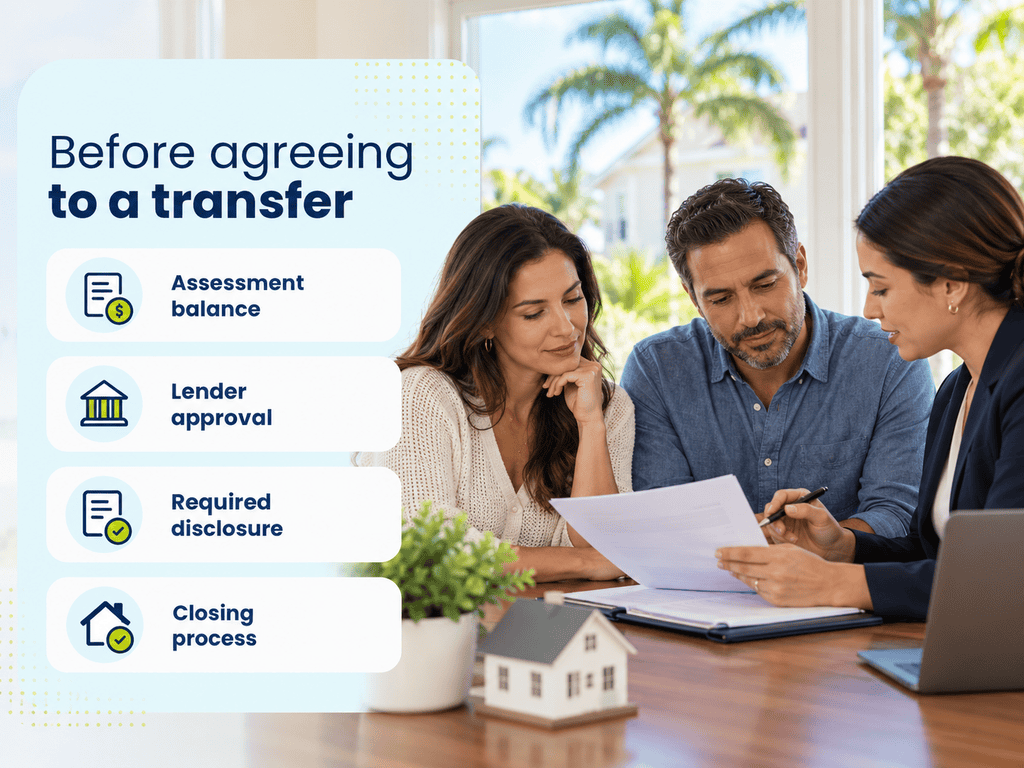
What sellers and buyers should review before agreeing to a transfer
The following table shows why transfer versus payoff shouldn’t be answered without looking at the complete transaction.
| Question | Why it matters |
| Is there an outstanding PACE assessment? | The remaining obligation needs to be identified during the sale. |
| What is the current payoff amount? | The amount may affect the seller’s expected proceeds. |
| Will the buyer use mortgage financing? | Mortgage underwriting may require the PACE assessment to be satisfied. |
| Does the lender permit an outstanding PACE lien? | Lien-priority rules can determine whether transfer is practical. |
| Has the required disclosure been provided? | Florida law requires disclosure of an unpaid qualifying-improvement assessment in covered residential sales. |
| Will the buyer accept the assessment? | Even if transfer is legally possible, the buyer may negotiate for payoff. |
| How will payoff be handled at closing? | The seller, servicer and closing professional need to coordinate payment and documentation. |
| How long could lien removal take? | County processing can affect the transaction timeline. |
These are transaction questions, not just PACE questions. Your lender, real-estate professional, title company or attorney may each be responsible for different parts of the answer.
How the assessment can affect your expected sale proceeds
One issue sellers sometimes overlook is how a required PACE payoff affects the amount of money they receive after closing.
For example, a seller might initially estimate their proceeds by subtracting the existing mortgage balance and selling expenses from the expected sale price.
If an outstanding PACE assessment must also be paid in full, the payoff reduces those proceeds further.
That doesn’t mean the original improvements provide no value to the property. A qualifying improvement, such as a new roof or upgraded windows, may still be relevant to the property’s condition and appeal to buyers.
However, the value a buyer places on an improvement isn’t automatically equal to the unpaid financing balance.
A real-estate professional can help assess the property’s likely market value while the closing professional calculates the financial obligations that must be satisfied.
Why future sale plans matter before choosing PACE
Sale considerations aren’t only relevant to homeowners who already have PACE financing.
They are also worth considering before entering into a new PACE assessment.
Ygrene’s current guidance encourages property owners to consider the likelihood and timing of a possible sale or refinance alongside the potential cost of repaying the assessment.
For example, a homeowner planning to remain in a property for many years may evaluate a long-term financing arrangement differently from someone who expects to move relatively soon.
Before signing, homeowners should review:
- The amount financed
- The interest rate and finance charges
- The expected property-tax assessment
- The financing term
- Total repayment obligations
- The effect on mortgage escrow, if applicable
- Early-payment terms
- Sale and refinance considerations
- The contractor agreement
- Required disclosures
Homeowners considering PACE for a qualifying property improvement can review how Ygrene PACE financing works to understand the property-assessment structure and repayment process.
It’s also worth reviewing the company’s consumer protections and financing disclosures, including how financing terms, repayment obligations and potential risks are explained before an agreement is signed.
Why the financing term matters if you plan to move
A longer financing term can spread payments over more years, but it also means an assessment balance may remain when a homeowner decides to sell.
If the property is sold before the assessment is fully repaid and the buyer’s lender requires payoff, the homeowner may have to satisfy the remaining obligation sooner than originally planned.
Before entering a financing agreement, consider how long you reasonably expect to own the property.
You don’t need to predict the exact year you’ll move. However, you should understand how an earlier-than-expected sale could affect your finances.
PACE may be useful for an eligible property improvement, but the ability to finance a repair today should be weighed alongside what the assessment could mean if you sell before the financing term ends.
Plan for your PACE assessment before listing your home
If you’re selling a home with Ygrene PACE financing, don’t assume that the assessment will automatically transfer to the buyer.
Current Ygrene guidance says homeowners will very likely need to pay off the remaining PACE assessment during a sale because most mortgage lenders require repayment before closing. Florida law also requires disclosure of an unpaid qualifying-improvement assessment to prospective buyers.
Before listing, review your financing agreement, request an up-to-date payoff amount and discuss the assessment with your real-estate and closing professionals. If a mortgage lender is involved, confirm its requirements early.
For homeowners considering Ygrene financing for a future property improvement, it’s equally important to think about how long you expect to own the home and whether you may need to refinance or sell before repayment is complete.
If you already have an outstanding Ygrene PACE assessment and plan to sell, start by requesting an official payoff quote and confirming the servicing requirements for your anticipated closing date. That gives you and your closing team a clearer picture of the remaining obligation before the transaction moves forward.
FAQs
Does PACE financing have to be paid off when you sell your home?
In most cases, homeowners should expect that payoff may be required. Ygrene currently says property owners will very likely have to pay off the remaining PACE assessment during a sale because most mortgage lenders require repayment as a condition of the transaction. The exact requirement depends on the financing agreement, buyer’s lender and transaction.
Can I transfer PACE to the buyer?
A PACE assessment is legally connected to the property and property-tax assessments can be transferable. However, that doesn’t mean a buyer can automatically take over the assessment because the buyer’s mortgage lender may require it to be paid in full before closing. Sellers should confirm the requirements before agreeing to a transfer.
Does a PACE assessment make it impossible to sell a house?
No. Having an outstanding PACE assessment doesn’t by itself mean the property can’t be sold. The seller may need to obtain a payoff quote and arrange for the assessment to be satisfied as part of the closing process.
Do I need to disclose PACE financing when selling in Florida?
Yes, when the residential property is subject to an unpaid assessment covered by Florida’s PACE statute. Florida law requires the seller to give the prospective purchaser a written disclosure at or before the seller executes the sales contract. A real-estate attorney or qualified closing professional can help confirm that the required disclosure is completed correctly.
Can I use the proceeds from my home sale to pay off PACE?
A PACE payoff may be coordinated as part of a closing when permitted by the transaction and closing arrangements. Ask your title company, closing agent or attorney how the payoff would be funded and documented for your particular sale. Remember that the assessment payoff will reduce the proceeds otherwise available to the seller.
How early should I request my Ygrene payoff quote?
Ygrene currently recommends requesting a full payoff quote at least two weeks before a home sale or refinance closing. Its servicing information says a payoff quote typically takes two business days, but additional time may be necessary for closing coordination and county lien-release procedures.
Can I pay off Ygrene PACE financing early?
Ygrene currently states that residential homeowners can make full or qualifying partial early payments without a prepayment penalty. You should still request the current payoff amount and review your own financing agreement because accrued interest and any applicable administrative costs may affect the final figure.