
Choosing between storm shutters vs impact windows is rarely about storm protection alone. Florida homeowners also need to weigh upfront project cost, how much preparation each option requires, building and insurance requirements and how long they expect to stay in the home.
This guide compares both storm protection options from a practical homeowner perspective. By the end, you’ll know what changes the cost, how the two approaches differ during hurricane preparation and what to check before requesting contractor or financing quotes.
Storm shutters vs impact windows: The main differences
Both impact-rated windows and approved storm shutters can protect vulnerable openings from windborne debris when the products, installation and application meet the applicable requirements.
The biggest difference is how that protection becomes part of the home.
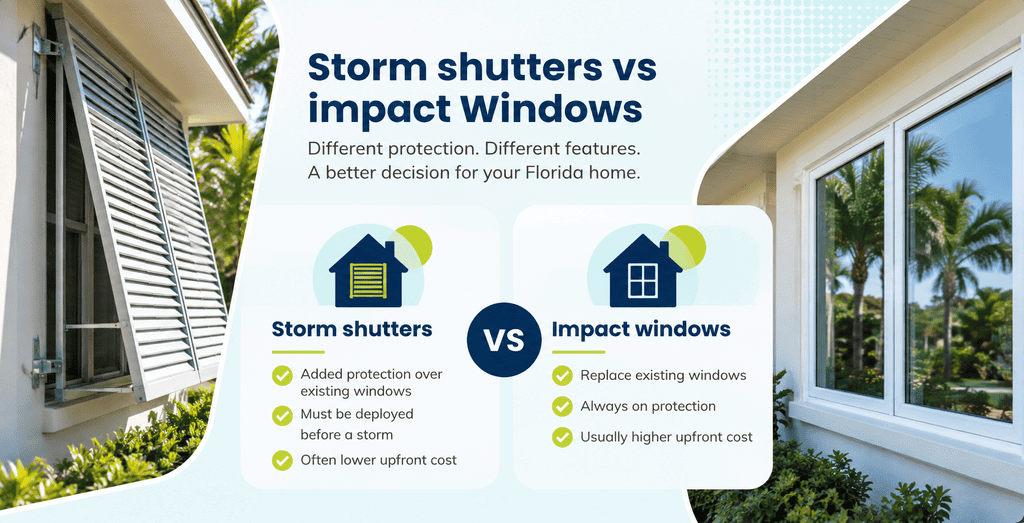
Impact windows replace the existing window assembly. The glass, frame, anchoring and other components work together as an impact-resistant system. Once properly installed, there’s no shutter to close or panel to mount before a storm.
Shutters add a protective system over an existing opening. Depending on the type, you might close an accordion shutter, lower a roll-down system or install individual storm panels before severe weather arrives.
That creates several practical differences:
| Factor | Storm shutters | Impact windows |
| Upfront project scope | Usually narrower because existing windows may remain | Usually broader because the windows themselves are replaced |
| Storm preparation | Some systems must be deployed before a storm | No separate deployment is normally required |
| Year-round appearance | Hardware or shutters may remain visible depending on the design | Functions as the home’s everyday window system |
| Existing window condition | Can protect openings without necessarily replacing aging windows | Replaces old windows as part of the project |
| Maintenance | Tracks, fasteners, motors or removable panels may need attention | Window hardware, seals and frames still require normal maintenance |
| Insurance documentation | Product and installation details matter | Product and installation details matter |
| Cost comparison | Often lower upfront, but varies widely by shutter type | Often higher upfront because each opening receives a replacement window system |
This is why comparing the two only by the price of the materials can be misleading. A useful comparison starts with the condition of your existing windows and what you actually want the project to accomplish.
Florida law includes impact-resistant or hurricane windows and storm shutters among improvements that may qualify under the state’s PACE framework. The Florida PACE statute provides the legal framework for qualifying improvements.
Ygrene also includes high-impact windows, opening protections and storm shutters among its current PACE-eligible home improvements. Property, project and jurisdiction requirements still apply.
How shutters protect an opening
A compliant shutter system creates a barrier in front of a window, glass door or other opening. Products can include removable storm panels, accordion shutters, roll-down shutters and other approved systems.
The shutter has to be suitable for the specific opening and installed according to its approved configuration. Fasteners, tracks, anchors and the substrate they attach to all matter. Buying a hurricane-rated panel doesn’t by itself mean the completed installation meets local requirements.
For example, Miami-Dade County requires product approval information when permitting shutters and storm panels. Its requirements for windows, shutters and doors call for drawings identifying protected openings plus a current Notice of Acceptance or acceptable Florida Building Commission product approval for the proposed system.
How impact windows protect an opening
Impact-resistant windows combine an impact-rated glazing system with a frame and anchoring method designed for the applicable pressures and debris exposure.
Homeowners sometimes focus entirely on the glass. The complete assembly matters. A product needs to be appropriate for the opening, building and installation conditions.
Local permitting requirements can vary based on where the property is located, the work being performed and the characteristics of the building.
For that reason, ask your contractor to identify the product approval and permit requirements that apply to your property rather than relying on a generic claim that a window or shutter is “hurricane proof.”
Hurricane shutters vs windows cost: What actually changes the price?
When homeowners compare hurricane shutters vs windows cost, shutters generally start with an important advantage: they may protect the opening without requiring removal and replacement of every existing window.
That doesn’t mean every shutter project is inexpensive or that impact windows are always the more costly choice for the homeowner’s overall needs. The total scope can change the comparison considerably.
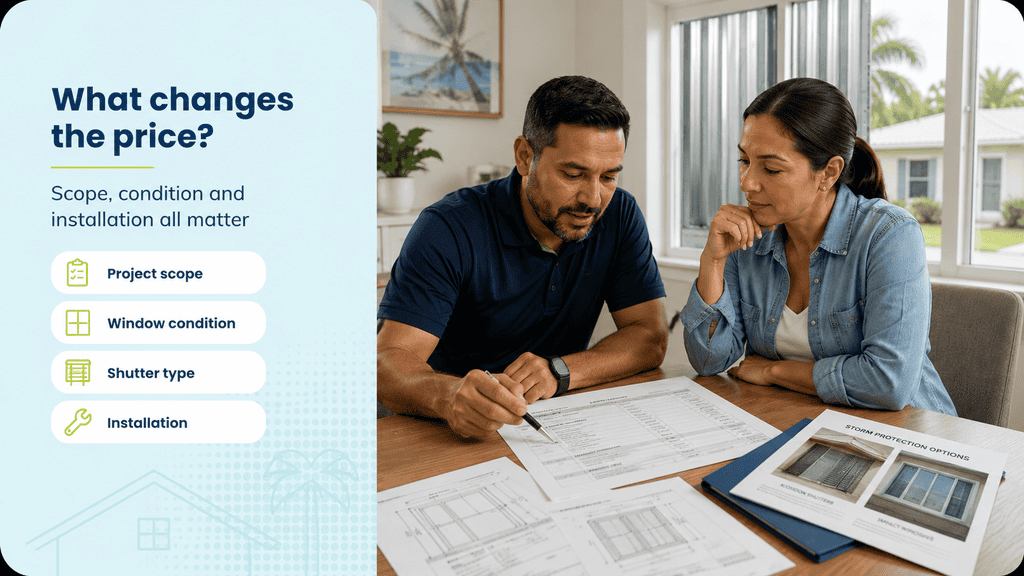
A home with relatively new, functional windows may be a good candidate for adding an approved shutter system. A home with deteriorated frames, failed seals, water intrusion or windows that already need replacement presents a different calculation. Paying to protect windows that will soon need to be replaced can mean completing two separate projects over time.
Ygrene’s current guidance on Florida windows and doors also distinguishes approved storm shutters from impact-rated replacements and notes that the right choice depends on factors such as the home’s location, age and insurance requirements.
Shutter type changes the cost
“Storm shutters” describes several products rather than one uniform system.
Removable panels tend to involve more homeowner labor because they have to be stored, carried to the openings and installed when needed. Permanent systems such as accordion or roll-down shutters reduce that setup but add hardware and installation complexity.
Motorized systems can add electrical components and future service needs. Very large openings, balconies, second-story windows and unusual wall conditions can also change the installation.
A quote should therefore identify the shutter type for each opening rather than giving you one unexplained whole-home price.
Impact-window quotes involve more than glass
A replacement window proposal can include:
- Removal and disposal of the existing windows.
- New impact-rated window assemblies sized for each opening.
- Installation materials, anchors and labor.
- Interior or exterior finishing around disturbed openings.
- Permit costs where applicable.
- Related door or sliding-glass-door work if those openings are included.
Different frame materials, window styles and opening sizes can substantially change the total.
Before comparing two bids, check whether both contractors priced the same number of openings and the same scope. One contractor may include sliding doors, permit work or finishing that another has excluded.
Compare lifecycle inconvenience as well as purchase price
There’s another cost that won’t necessarily appear on an invoice: storm preparation.
If you choose removable panels, consider who will install them before each storm and remove them afterward. For a one-story home with accessible openings, that may be manageable. For a homeowner with second-story openings, limited storage or physical limitations, it may be a significant concern.
Permanent shutters reduce some of that work. Impact windows reduce it further because there’s no separate window-protection system to deploy.
That convenience doesn’t automatically justify a higher project cost. It simply belongs in the decision along with the contractor price.
A better way to compare quotes
Ask contractors to provide line-item proposals where possible. For each option, confirm:
- Which openings are included in the price.
- The manufacturer, product model and approval information.
- Whether permits are included.
- Whether removal and disposal are included.
- What interior or exterior repair work is included after installation.
- What warranties apply to the product and contractor workmanship.
- Which costs could change after the contractor inspects the openings.
That comparison tells you much more than asking for a statewide “average cost.” Florida homes differ too much in opening size, construction type, access and product selection for one average to describe every project accurately.
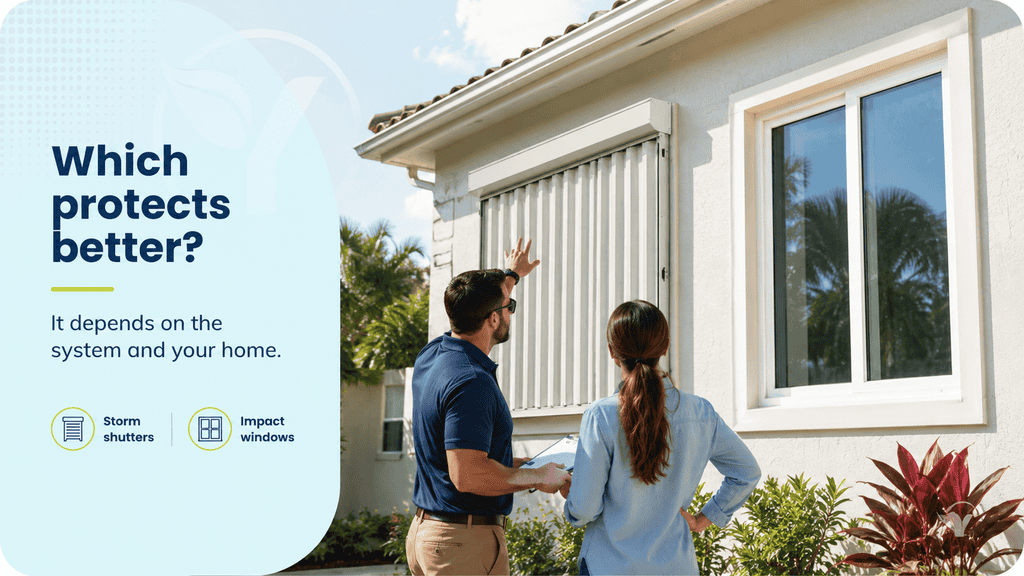
Which option provides better storm protection?
There isn’t a useful answer based simply on the words “window” or “shutter.”
An approved shutter that’s correctly installed and fully deployed can provide opening protection. A compliant impact-rated window can also provide opening protection without a separate shutter.
The better choice depends on whether the system is suitable for your home, installed correctly and used as designed.
Impact windows remove the deployment step
The clearest practical advantage of impact windows is that protection doesn’t depend on you installing panels or closing a separate shutter before the storm.
That can matter when a storm changes direction, you’re away from the property or preparation time is limited.
It also means you don’t need storage space for removable panels or a plan for identifying which panel fits each opening.
Shutters can protect good existing windows
If your existing windows are in good condition, shutters let you add storm protection without automatically replacing them.
That can make shutters an attractive choice for homeowners whose main priority is opening protection rather than window replacement.
The tradeoff is that deployable systems need to be ready when required. Tracks should operate correctly, removable panels should be accessible and homeowners should know how the system is secured before a storm is approaching.
Neither choice solves every vulnerability in the home
Windows are one part of a building envelope.
A house may also have exterior doors, garage doors, roof connections, roofing materials and other components that affect its wind resistance. Replacing windows doesn’t address all of those areas.
The Florida Department of Financial Services hurricane mitigation guidance describes opening protection alongside other mitigation measures homeowners may consider.
That makes a whole-home view useful. Before spending a large portion of your project budget on one improvement, find out whether another weak point also needs attention.
Insurance, permits and product approval deserve a separate check
Storm protection can affect more than hurricane preparation. Florida homeowners often consider impact windows or shutters partly because documented mitigation features may qualify for homeowners insurance credits.
That possibility should be treated carefully. An installation doesn’t guarantee a particular premium reduction.
The Florida Department of Financial Services explains that admitted insurers must provide information about available hurricane-loss mitigation discounts. It also states that insurers must accept a valid Uniform Mitigation Verification Inspection Form completed and signed by an eligible professional. Homeowners can review the state’s wind mitigation notices, inspection requirements and forms before relying on a projected discount.
Ask your insurer before using savings to justify the project
If insurance savings are part of your decision, contact your insurer or insurance agent before signing the installation contract.
Ask:
- Whether the proposed type of opening protection can affect your policy.
- What documentation the insurer will require.
- Whether a new wind mitigation inspection will be needed.
- Whether every exterior opening needs qualifying protection for the credit you expect.
- How the change would affect the wind portion of your premium rather than relying on a contractor’s estimate.
A contractor can explain the product being installed. Your insurer determines how the completed work affects your specific policy.
Check approvals before installation
For either option, ask for the exact product approval documentation before work starts.
This matters particularly in areas with stringent wind and impact requirements. Miami-Dade County maintains an official product approval system covering windows, exterior glazing, doors and shutters.
The correct approval also needs to match the way the product will actually be installed. Opening dimensions, design pressures, anchors and substrate conditions may affect whether a product is appropriate.
Permit requirements are local, so homeowners should also check with the applicable building department or confirm that the contractor is handling the necessary permit process.
Don’t assume every Florida home has the same code requirement
Florida building requirements depend on factors including location, building type, project scope and when the structure was built.
A rule that applies to replacement windows in one jurisdiction or building may not apply in exactly the same way elsewhere.
Rather than trying to determine compliance from a product advertisement, ask the contractor to identify the current code and permit requirements for your address. If you’re uncertain, confirm them with the local building department.
How to decide which storm protection option fits your home
A useful decision begins with the existing condition of the house, not with a product preference.
Consider this hypothetical example.
A Florida homeowner has 20-year-old windows. Several are difficult to open, two have fogging between the panes and there are signs of water intrusion around one frame. Adding shutters may protect those openings from storm debris, but it doesn’t correct the existing window problems.
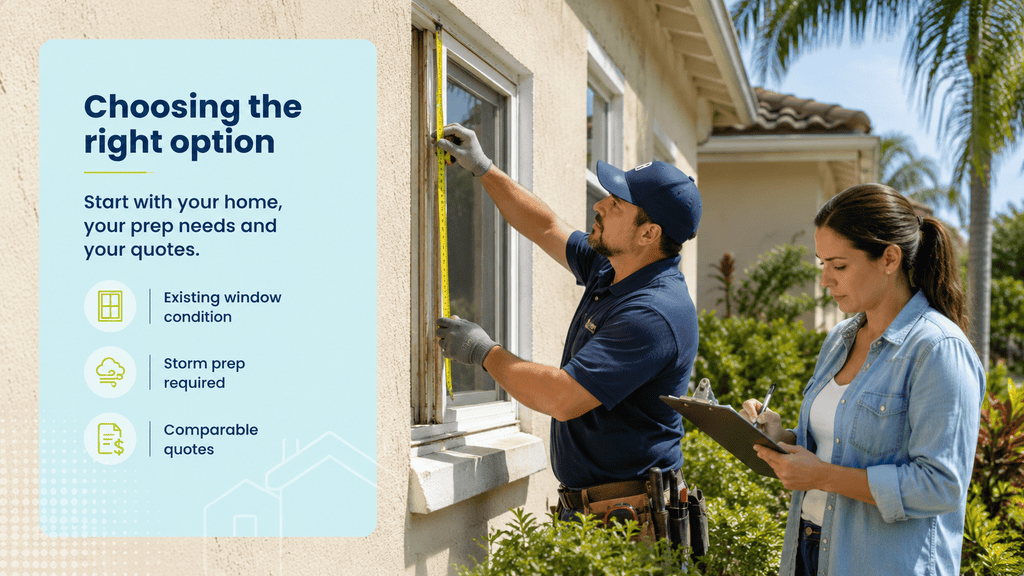
For that homeowner, getting a replacement impact-window proposal makes sense because the project may address two needs at once.
Another homeowner may have newer windows that work well but lack an approved opening-protection system. That person may find that shutters address the immediate storm-protection goal without replacing functional windows.
Neither homeowner should make the decision based on the project category alone.
Use this decision process before requesting final bids
1. Inspect the existing windows and doors.
Look for damaged frames, failed seals, water staining, difficult operation and other conditions that could make replacement necessary regardless of storm protection.
2. Decide how much storm preparation you’re willing to do.
If removable shutters are being considered, think through storage, installation time, upper-story access and who will deploy them if you’re away.
3. Get comparable quotes.
Ask contractors to price the same openings and clearly separate products, permit work and any finishing costs.
4. Verify product approvals and permits.
Confirm that the proposed products and installation methods are suitable for your property and local requirements.
5. Speak with your insurer.
If mitigation discounts matter to your decision, find out how the insurer evaluates the proposed improvement and what documentation will be needed.
6. Compare the full financial commitment.
If you’ll finance the work, compare the financing amount, interest rate, finance charges, repayment period, total repayment and early-payoff provisions rather than looking only at the periodic payment.
What if you need financing for shutters or impact windows?
Replacing windows throughout a house or installing a permanent shutter system can be a substantial project. Homeowners who don’t want to pay the full cost at once may compare cash, home-equity financing, personal loans, contractor financing and PACE financing where available.
Florida law includes replacement windows, doors and storm shutters among improvements that can fall within the state’s PACE financing framework when applicable requirements are met. The Florida statute governing PACE assessments provides the underlying legal requirements.
Ygrene currently lists high-impact windows and storm shutters among its eligible residential improvements. Before treating PACE financing as an option, confirm that your property is located in one of Ygrene’s current Florida service areas and that the proposed project meets program requirements.
How Ygrene PACE financing differs from a conventional loan
PACE financing is a property assessment rather than a traditional personal loan.
Ygrene explains that the financing is repaid through the property-tax system and secured by the improved property. A first-priority lien for the total amount financed will be placed on the property as collateral. Available terms vary by service area and improvement type. Homeowners considering this route should review how Ygrene PACE financing works before comparing it with other financing choices.
Because the assessment is tied to the property, future plans for the home matter. Ygrene’s PACE financing FAQs advise homeowners to consider a possible sale or refinance and discuss relevant lender requirements before proceeding; the property owner will very likely have to pay off the PACE financing in the event of a sale or refinance.
Compare financing by total obligation, not just payment size
A longer repayment period can reduce the amount due during each payment period but can increase the amount of interest paid over time.
Before signing, review:
- The amount being financed.
- The interest rate and applicable finance charges.
- The chosen repayment term.
- The projected total repayment.
- How the assessment will appear on your property-tax bill.
- How escrowed taxes may affect mortgage payments.
- Early-payoff provisions.
- The implications of a future sale or refinance.

Ygrene’s consumer protection information explains its disclosure process and financing agreement review. Homeowners should still read the complete financing agreement and contractor documents themselves before signing.
PACE isn’t a government sponsored program and there is no government assistance available to pay the assessment. The contractor, not Ygrene, performs the installation. Homeowners remain responsible for reviewing both the contractor agreement and the financing documents.
For decisions involving your specific mortgage, taxes, insurance or future property transaction, consider speaking with the appropriate mortgage, tax, insurance, legal or real-estate professional.
Check the home before choosing the protection
The most useful storm shutters vs impact windows comparison starts with three questions: Are your current windows still worth keeping? How much storm preparation are you willing to handle? What will the complete project cost after installation, permitting and related work?
If the existing windows are performing well, approved shutters may provide the protection you want with a smaller project. If the windows already need replacement, comparing impact-rated replacements can prevent you from paying to protect components you expect to remove later.
Florida homeowners considering PACE financing can check whether Ygrene currently serves their jurisdiction and whether the proposed storm-protection project qualifies. Before proceeding, compare the contractor scope, financing terms and property-tax obligation with the other funding options available to you.
FAQs
Are impact windows better than hurricane shutters?
Not in every situation. Both can provide effective opening protection when approved for the application and correctly installed. Impact windows offer year-round protection without deployment while shutters may let you protect existing windows at a lower initial project cost.
Are hurricane shutters cheaper than impact windows?
Storm shutters generally have a lower upfront scope because they can be installed over existing windows rather than replacing them. The actual difference depends on shutter type, number and size of openings, access, permitting and the condition of your existing windows.
Do impact windows eliminate the need for hurricane shutters?
An impact-rated window system approved for the applicable opening-protection requirements generally serves as the protection for that opening. Homeowners should still confirm the specific product approval and local permit requirements with their contractor or building department.
Can storm shutters or impact windows lower homeowners insurance?
They may qualify as hurricane-loss mitigation features, but the effect on an individual premium depends on the property, insurer and documented mitigation characteristics. Florida homeowners should confirm required documentation with their insurer and review the state’s wind mitigation guidance rather than assuming a specific savings amount.
Do storm shutters have to be installed before every hurricane?
It depends on the system. Removable panels have to be mounted and deployable shutters such as accordion or roll-down systems have to be closed to provide their intended protection. Impact windows don’t require a separate deployment step.
Can Ygrene finance both impact windows and storm shutters?
Ygrene currently lists high-impact windows and storm shutters among eligible residential improvements in Florida. Property eligibility, jurisdiction availability, project requirements and financing terms still have to be confirmed before proceeding.
Is Ygrene financing a home-improvement loan?
Ygrene PACE financing is structured as a property assessment rather than a conventional consumer loan; a first-priority lien will be placed on the property as collateral. Repayment occurs through the property-tax system, so homeowners should review the assessment, repayment, payoff and sale or refinance implications before signing.